
Collector's Insight
Collecting Klara and the Sun: The Complete Edition Guide
Faber's 200-copy limitation, the Waterstones sprayed-edge exclusive, the independent bookshop variant and the Folio Society signed 100 — what to buy, what to avoid, and what it is all worth in 2026
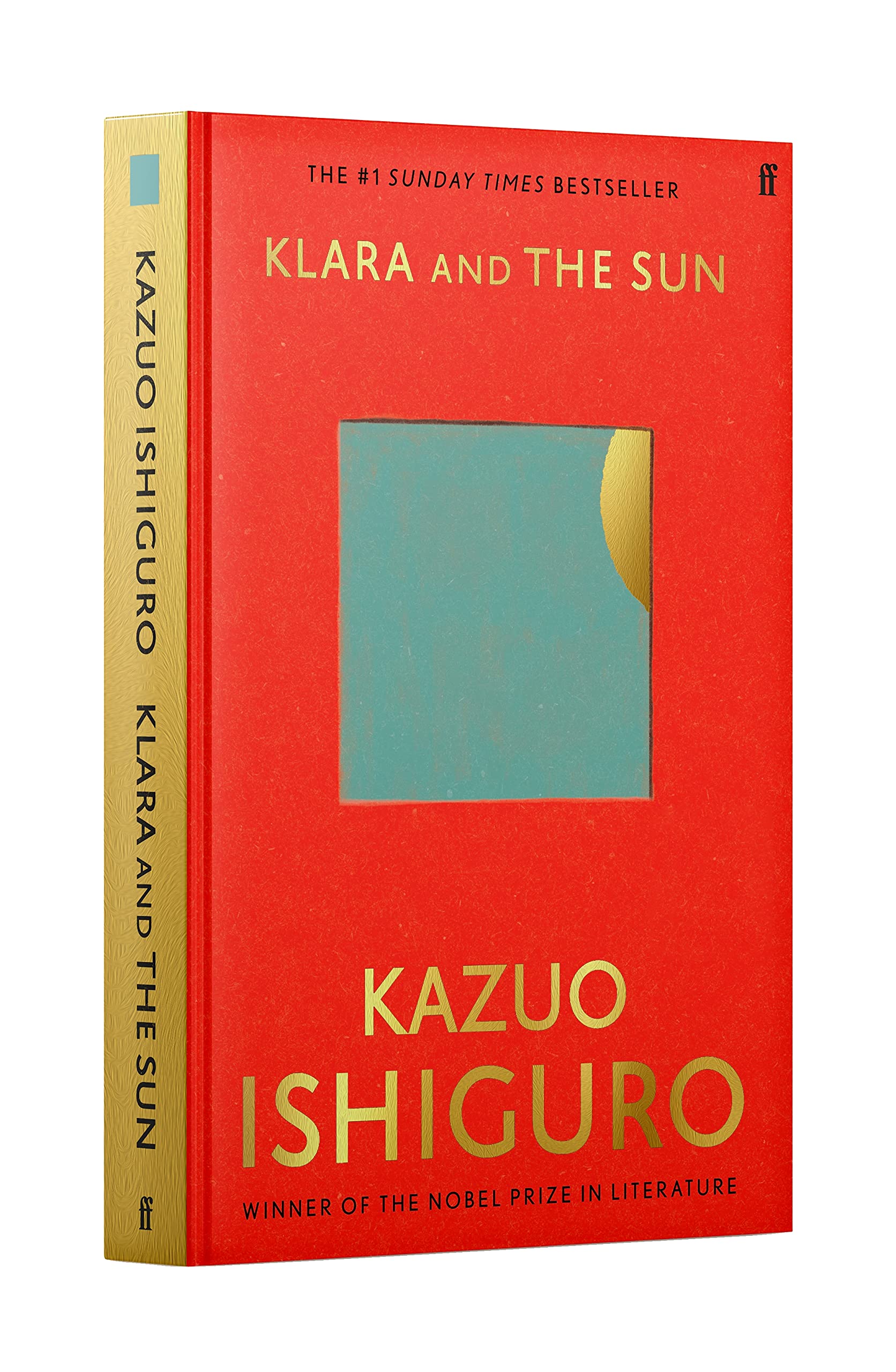
Kazuo Ishiguro's first novel after the Nobel Prize arrived in March 2021 with an unusually crowded field of collectable states: a signed Faber limitation of 200 numbered copies that sold out before publication, a Waterstones sprayed-edge exclusive, an independent bookshop edition with an alternative jacket, and a later Folio Society illustrated edition signed in an issue of 100. This guide sets out the edition points, corrects a persistent myth about the Waterstones exclusive, and compares current secondary market values across every configuration. With the Taika Waititi film adaptation due in October 2026, it also assesses which states are likely to hold value and which are noise.
Collecting Klara and the Sun: The Complete Edition Guide
Faber's 200-copy limitation, the Waterstones sprayed-edge exclusive, the independent bookshop variant and the Folio Society signed 100 — what to buy, what to avoid, and what it is all worth in 2026
Contents
Holding a copy and want to know what it is? Go straight to Identification: Telling the States Apart — four tests, quickest first. Want to know what it's worth? Secondary Market Values. Everything else reads in order.
- Introduction: The Nobel Laureate's First Post-Prize Novel
- Publishing History
- The Design: Why There Are Four Jackets
- Editions & Print Runs
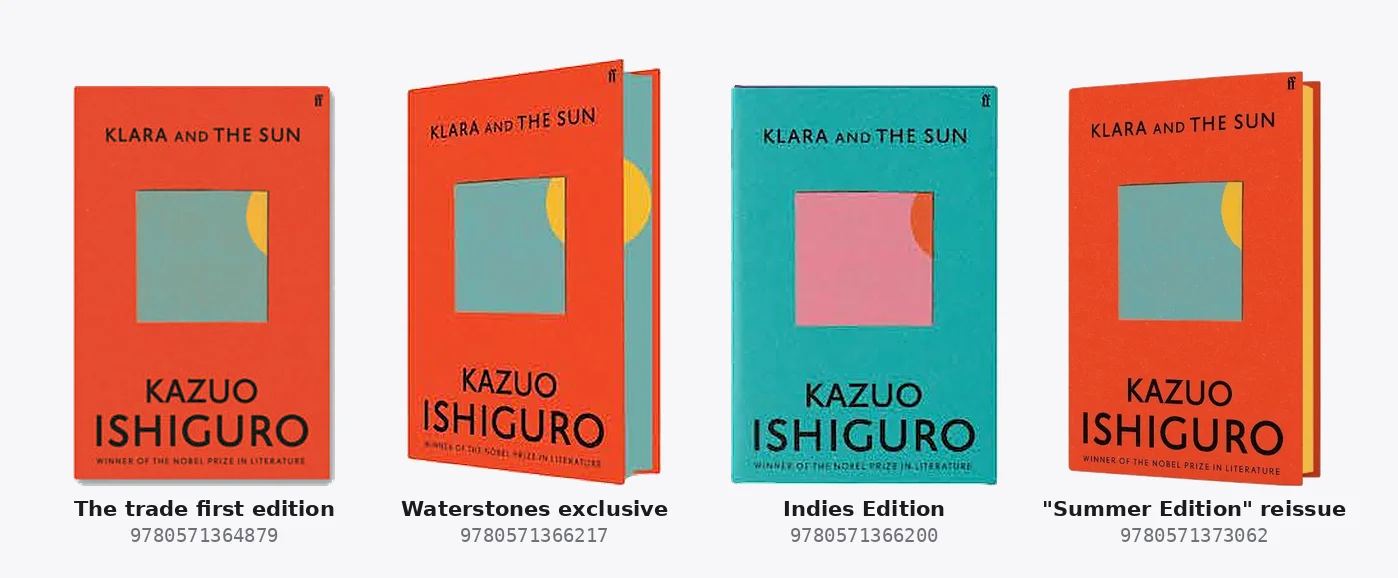
- The UK trade first edition (Faber & Faber)
- The Waterstones editions — three records, two books
- The extra-chapter myth
- The Indies Edition — the turquoise-jacket variant
- The Faber signed limited edition — the key modern collectable
- The Faber Members print — a separate collectable, in two states
- The US and Canadian first editions
- The Folio Society illustrated edition (2025)
- The 2026 film tie-in — for completeness, not for the shelf
- A note on Goldsboro Books
- Identification: Telling the States Apart
- The Collector's Guide
- Secondary Market Values
- Kazuo Ishiguro: The Wider Collection
- Snap Facts: Kazuo Ishiguro
- Sources, References and Deductions
Introduction: The Nobel Laureate's First Post-Prize Novel
There are modern first editions, and then there are books that publishers know are going to matter before a single copy ships. Klara and the Sun was firmly the second kind. It was Kazuo Ishiguro's eighth novel, his first full-length work of fiction since The Buried Giant (2015), and — critically for collectors — his first novel published after he received the Nobel Prize in Literature in 2017.
That combination produced something unusual in contemporary British publishing: a literary novel treated by the trade like a genre event. Faber issued a signed, numbered, slipcased limited edition that sold out before publication day. Waterstones commissioned a sprayed-edge exclusive. The UK independent bookshop network got its own signed variant with a different jacket entirely. Four years later, The Folio Society added an illustrated edition with a 100-copy signed state. For a single title published in 2021, that is a genuinely crowded field of collectable configurations — and it is exactly the sort of situation where a collector who understands the hierarchy pays £90 for something a less careful buyer pays £250 for.
There is also a live catalyst. Taika Waititi's film adaptation, with Jenna Ortega as Klara and Amy Adams as Chrissie, is scheduled for theatrical release in October 2026 — within weeks of this article's publication. Screen adaptations reliably move the market for a book's scarce states, and just as reliably flood it with worthless tie-in printings. Knowing which is which is the whole game.
That is harder than it should be, because the published record on this title is unreliable. Retailer pages give a March 2021 publication date to an edition that did not exist until June. Dealers describe the same fore-edge as green, as yellow-green and as yellow, apparently at random. The independent bookshop jacket is catalogued as blue by nearly everyone including, until recently, this writer — the designer calls it turquoise. And a thirteen-digit number that validates perfectly as an ISBN, and is quoted as one across the trade, turns out not to be an ISBN at all.
This guide sets out to fix each of those, from primary sources: the designer's own account of the commission, Faber's copyright page, Waterstones' own launch images, and archived captures of the listings as they stood in 2021. Three findings in particular do not appear to be recorded accurately anywhere else — the true publication date of the Summer Edition, the copyright-page evidence that Faber planned all three UK states as a single simultaneous issue, and the reason the trade cannot agree about the colour of the Waterstones fore-edge.
The order below is deliberate. The design came first and determined everything after it, so it is explained first; the editions follow from it; identification follows from those; and value follows from all three.

Publishing History
Klara and the Sun was published simultaneously on 2 March 2021 by Faber & Faber in the United Kingdom and Alfred A. Knopf in the United States. A Knopf Canada edition followed the same publication cycle.
The novel is narrated by Klara, a solar-powered Artificial Friend observing the human household she joins from a position of imperfect, devotional understanding. It went to number one on the Sunday Times bestseller list, debuted at number six on the New York Times fiction list for the week ending 6 March 2021, and was longlisted for the 2021 Booker Prize and the 2022 Andrew Carnegie Medal for Excellence in Fiction. It appeared on The Washington Post's ten best books of 2021, The Times' 33 best books of 2021, and Barack Obama's 2021 summer reading list. The audiobook was narrated by Sura Siu; BBC Radio 4 broadcast an abridged ten-part reading by Lydia Wilson between 7 and 19 March 2021.
Two contextual points matter for the collector.
First, the pandemic shaped how this book was signed. Publication fell in the middle of the UK's third lockdown. There were no bookshop signing queues and no launch events. UK signed copies were produced by sending stock (or pre-publication sheets) to the author to sign at home — which is why almost every genuine UK signed copy carries an ink signature directly on the half-title or title page, and why a small number carry a pre-publication date alongside. In the US and Canada, Knopf took the more common North American route of tipped-in signed leaves and publisher's bookplates. This is the single biggest structural difference between the UK and US signed markets for this title, and it is permanently baked in.
Second, this was a very large first printing. Faber and Knopf both printed heavily against a Nobel laureate's return to the novel. The consequence is blunt but important: an ordinary unsigned first edition, first printing of Klara and the Sun is not scarce, has never been scarce, and is unlikely to become scarce in your lifetime. All of the collecting value in this title sits in the limited and signed states.
The Design: Why There Are Four Jackets
The four UK liveries are not four designs. They are one design in four keys — and we know this in unusual detail, because the designer wrote the process up himself.
The cover is by Pete Adlington, senior designer at Faber, who published a long account of the commission in Faber's own journal in May 2021. Three things in it matter to collectors.
The design was deliberately built to a formula. Adlington set out to achieve what he calls "the big book look" — a style he credits to the American jacket designer Paul Bacon, and which Steven Heller defined as "large, bold title, prominent author's name, small conceptual image." Adlington is disarming about it: "It might sound conceited to be knowingly designing to a template for commercial success but it is inevitable that I'll be steered in this direction." Once you know that, the jacket's proportions — the huge ISHIGURO, the small square motif — stop looking like a stylistic choice and start looking like a fifty-year-old commercial grammar being used on purpose.
Ishiguro intervened early. Adlington's first visuals presented the sun in fragmented compositions. One was liked in-house, but when the route was shown to the author, Ishiguro raised a concern that its composition resembled the Japanese flag — something he was keen to avoid. That route was dropped. The design that eventually won — the sun playing hide-and-seek behind a single window — Adlington produced thinking it was "maybe too simple to be the cover."
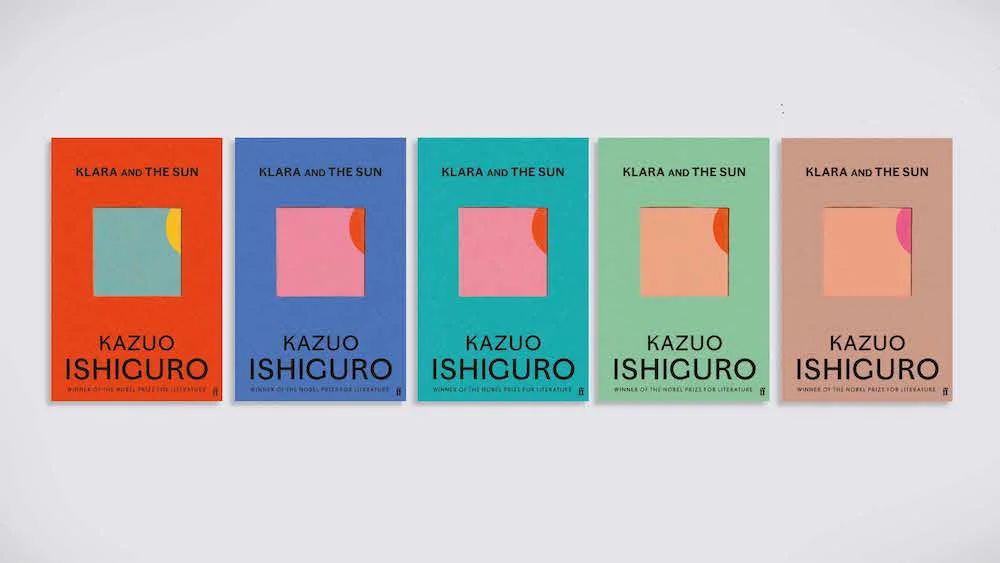
The variants came out of the colourway exercise. Red was the in-house favourite and was approved, with an amendment to the typeface; Adlington then rebuilt every element in a painterly style so the cover had a naive, warm, hand-made quality rather than a chilly digital one. Asked for colourway options, he produced the run of alternatives, and — in his own words — "In the end, we produced special editions both for Waterstones and independent bookshops, which allowed me to use the turquoise colourway for the independent edition."
That single sentence resolves the two exclusives:
- The Indies Edition wears the turquoise colourway from the design process — a sibling of the trade jacket, not a separate commission. (Dealers almost universally describe it as "blue," which is loose but understandable; the designer's own word is turquoise.)
- The Waterstones exclusive kept the original red jacket, and took its distinction from the printed edges and endpapers instead. The edges are not decorative colour: they carry the window design itself, so that, as Adlington puts it, "if angled right, you can imagine there's a whole sun floating there." The endpapers were drawn from his colour work, and those same panels were later enlarged into the campaign's reveal poster.
So Faber did not commission new artwork for either exclusive. It printed a road not taken, and it turned the jacket's own edges into a third surface for the motif. For a collector this is worth owning knowingly rather than by accident — and it explains why the two jackets sit so comfortably together on a shelf, which genuinely separate designs would not.
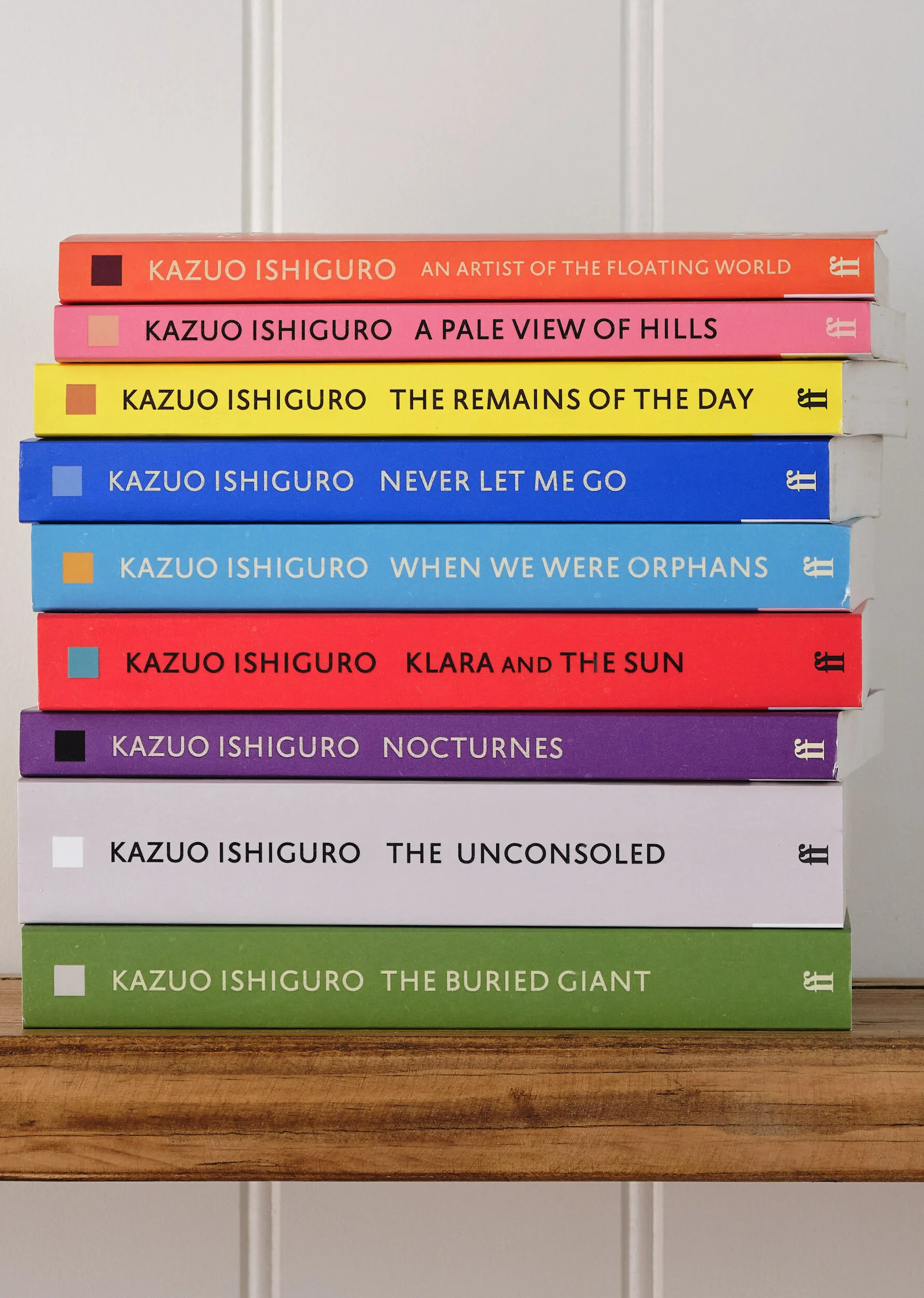
One consequence reaches well beyond this title. The Klara jacket's approval led Faber to rejacket Ishiguro's entire backlist to match — Adlington redesigned all eight of Never Let Me Go, The Remains of the Day, The Buried Giant, A Pale View of Hills, When We Were Orphans, The Unconsoled, An Artist of the Floating World and Nocturnes, carrying the central window device across the set. Anyone assembling a modern matched run of Ishiguro is therefore assembling an Adlington set that begins with this book. These are reading copies rather than collectable states, but as a coherent designed sequence they are the most attractive uniform Ishiguro has ever had.
Source: Pete Adlington, "Cover Design: Klara and the Sun," Faber Journal, 13 May 2021 (updated 7 March 2022).
The printed edge, and the endpapers
What the edge actually looks like — and why the trade cannot agree about it. Dealer listings for this edition variously describe the edges as green, as yellow-green, and as yellow, and those descriptions have circulated as though they were competing claims about one flat colour. They are not. The fore-edge of a confirmed 9780571366217 copy is not a single colour at all: it is a printed design — a sage blue-grey sky carrying a large yellow sun disc rising from the lower edge.
Once seen, the disagreement explains itself. A dealer describing the sky writes "green." A dealer describing the sun writes "yellow." Both are looking at the same book, both are honestly reporting what caught their eye, and neither description is adequate alone.
The sage is the same blue-grey as the panel inside the jacket's window — so the edge is not an abstract field with a circle on it, but the sky that window looks out on, with the sun rising into it.
It also delivers Adlington's intended effect exactly. The jacket's window carries a partial sun; the fore-edge carries the rest of it. Hold the closed book at an angle and the two resolve into a whole — "you can imagine there's a whole sun floating there," precisely as he described it. The edge is not decoration applied to the book; it is the third panel of the design.
This gives a far more robust test than colour ever could. The March exclusive has a pictorial edge. The June Summer Edition is described by Waterstones simply as a "yellow sprayed edge," with no design mentioned and none visible in their launch video. So the question to ask of any photograph is not what colour is the edge but is there a picture on it:
| Fore-edge | Issue | |
|---|---|---|
| 9780571366217 | Sage blue-grey sky with a yellow sun disc — a printed design | March 2021, first edition |
| 9780571373062 | Flat yellow, no design | 9 June 2021, later reissue |
That distinction survives bad lighting, poor photography and careless cataloguing in a way that "green versus yellow" never did.
Waterstones' own launch listing corroborates this directly: it carried three images — the jacket front-on, the book at an angle specifically to show the printed edge, and the endpapers. The retailer was selling the edge as a feature and photographing it deliberately, which is as close to a primary source as this question is likely to get.
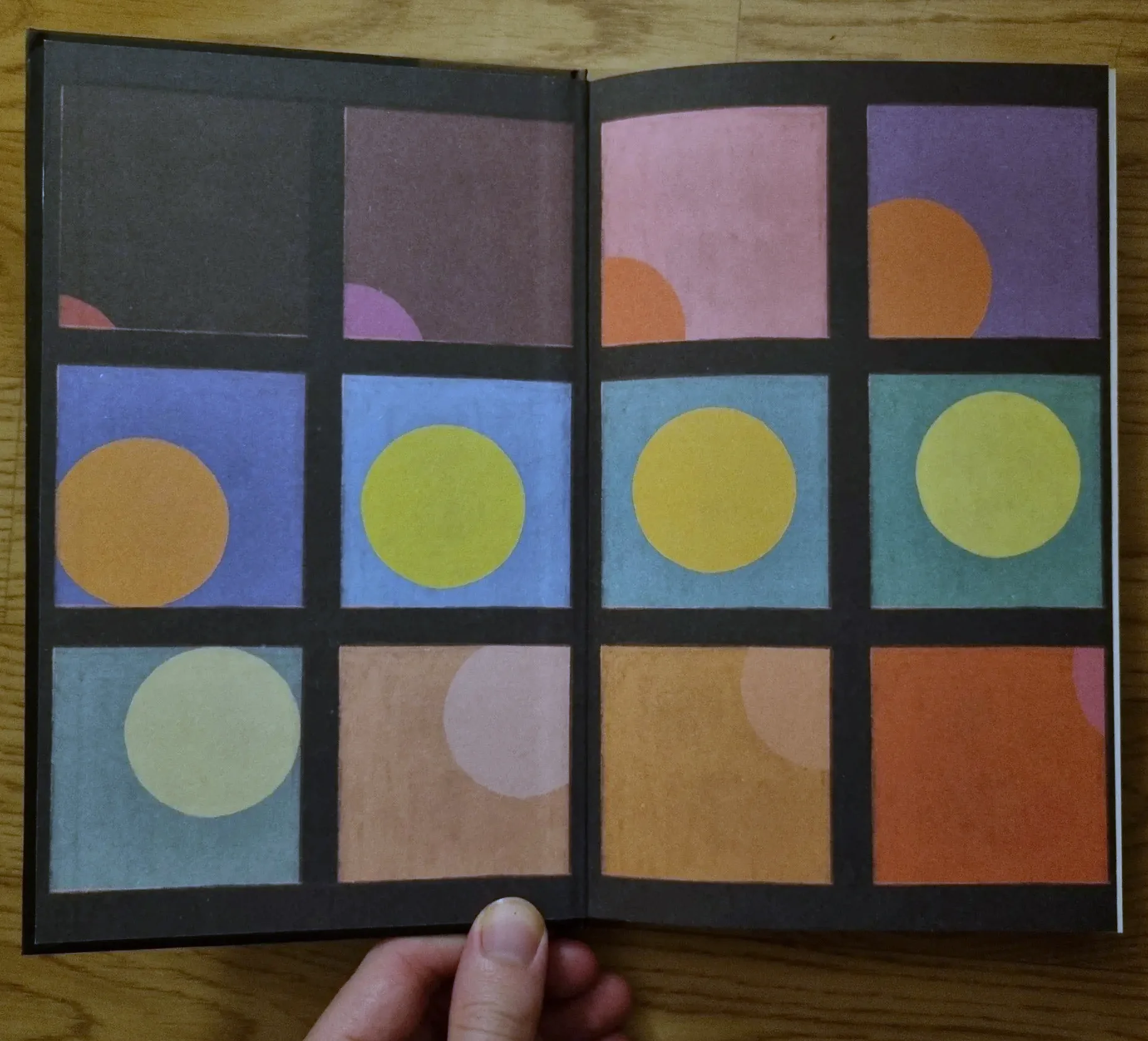
The endpapers are the third distinguishing feature, and the most striking. They reproduce Adlington's colour exploration as a grid of twelve panels — four across, three down — each a differently coloured square containing a sun disc, the sun shifting position and hue from panel to panel: maroon, purple and pink along the top, blues, greens and teal across the middle, tans, orange and red below. It is, in effect, the contact sheet of the whole design process bound into the book, and it is where the colourways that did not become jackets ended up.
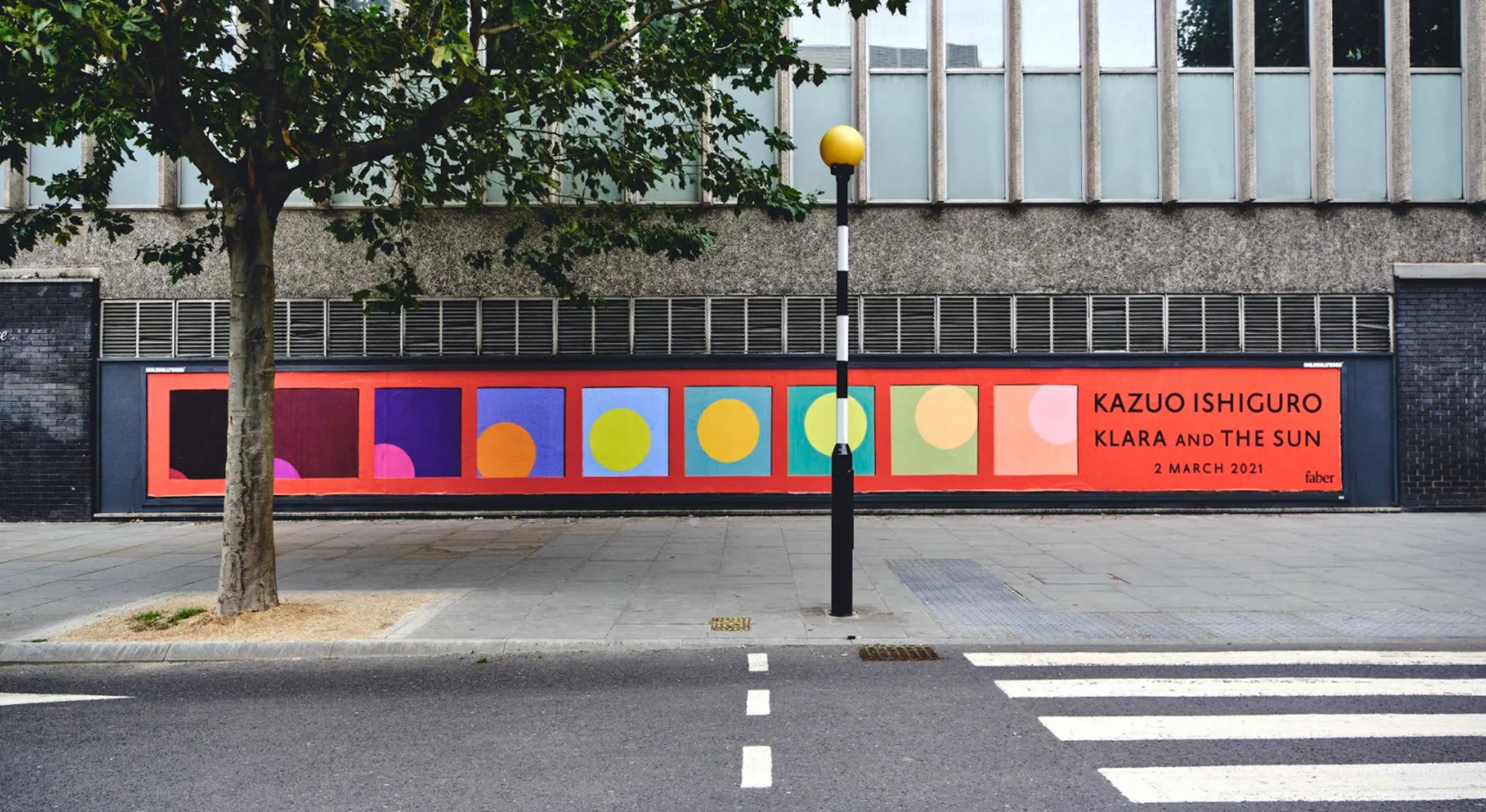
It is also the most literal statement of the novel's conceit anywhere in the production. Klara sees the world partitioned into boxes; the endpapers show the sun twelve times over, once in each box. Adlington notes that these same panels were subsequently enlarged for the campaign's reveal poster — a large-format street hoarding running the squares in a single row, with the author, the title and the publication date, 2 March 2021.
For identification purposes this matters as much as the edge. The exclusive endpapers are unique to 9780571366217 — the standard trade issue has plain endpapers, and Waterstones' description of the June Summer Edition mentions its yellow edge and no endpapers at all. A copy showing the twelve-panel sun grid inside the boards is the March exclusive, whatever else a listing claims.
Editions & Print Runs
The UK trade first edition (Faber & Faber)
- ISBN 9780571364879, hardback, £20.00 published price
- First printing identified by the full number line on the copyright page
- Jacket must be unclipped, showing the £20.00 price
This is the reference copy — the one every other UK variant is measured against. Some early retail copies were shipped with a promotional Klara bookmark, and a small number of sellers report an accompanying enamel badge from launch promotions; neither is a bibliographical point, but present-and-correct ephemera does add a few pounds with the right buyer.
The Waterstones editions — three records, two books
Waterstones' catalogue is where most collectors get confused, because it carries three separate product records for this title beyond the standard hardback, and they do not all describe the same physical book.
1. The Waterstones exclusive (unsigned) — ISBN 9780571366217, £20.00 Faber's exclusive issue for Waterstones. It keeps the standard red-orange jacket and takes its distinction from printed edges carrying the window design and exclusive endpapers drawn from the designer's colour studies. Unnumbered; no stated limitation was ever published. 2. The signed Waterstones exclusive — Waterstones product 2928377047306, £20.00 This is the same physical book as record 1, signed. Waterstones describes it as a "Signed exclusive edition" that "includes exclusive sprayed edges and endpapers." The book itself still carries ISBN 9780571366217.
That long number is worth a moment, because it fools people. 2928377047306 is not an ISBN, despite being thirteen digits and passing the check-digit test cleanly. Registered book ISBNs sit in the 978 and 979 Bookland ranges; EAN-13 codes beginning with 2 are reserved under GS1 rules for retailer internal use. Waterstones mints these for states that have no ISBN of their own — and a signed copy of an existing hardback is exactly that: the physical book is unchanged, so it cannot be issued a new ISBN, but the shop still needs its own line for it.
So a seller quoting 2928377047306 as though it were a fourth ISBN is describing a signature, not a different book. (a note on recording identifiers, for those who keep a catalogue.)
3. The "Exclusive Summer Edition" — ISBN 9780571373062, £20.00 — a different book entirely This one matters, and it is the trap in the group. Waterstones catalogues it as Klara and the Sun: Exclusive Edition and describes it in the blurb as the "Exclusive Summer Edition with yellow sprayed edge." It is a June 2021 reissue, not part of the March 2021 first-edition family.
The dating, from the archival record. Internet Archive captures of the Waterstones listing settle this. The page's earliest capture is 25 May 2021, at which point it was showing "Coming soon / Awaiting publication" with a pre-order button and no stock. By the capture of 10 June 2021 the same page reads "10+ in stock / Available."
That window closes tighter still on a second, independent source: Waterstones published a promotional video announcing the edition — captioned "Waterstones exclusive edition, out now" and showing the book's yellow sprayed edges — dated 9 June 2021, the day before the in-stock capture. Two unrelated records therefore converge on the same moment, and the Summer Edition can be dated to on or about 9 June 2021 — fourteen weeks after the novel was published.
And here is the detail every collector should take away. Both of those captures display, in the same panel, the line "320 Pages / Published: 02/03/2021" — on 25 May 2021, directly above the words "Awaiting publication." A retailer page cannot coherently state that a book was published in March and is awaiting publication in May. That contradiction is the proof that the date shown on these listings is inherited work-level metadata, applied to every variant record of the title regardless of when the individual issue actually appeared. It is not, and has never been, a printing date. The record also lists the book as "Edition: Main" — Faber's own designation carried no special-edition flag at all.
So: a yellow-edged Summer Edition is not a first printing and should never be bought as one. It resembles the original exclusive closely enough in a photograph that the two get conflated, and the pub-date artefact gives a careless seller cover for describing a June reissue as a March 2021 first — with the retailer's own page apparently corroborating them. Check the ISBN, check the edge colour, and check the number line.
Sources: Internet Archive captures of the Waterstones listing for 9780571373062, 25 May 2021 and 10 June 2021.
Is there a picture on the fore-edge? A sage sky with a yellow sun disc = 9780571366217, the March 2021 first-edition exclusive. Flat yellow, no design = 9780571373062, the 9 June 2021 Summer Edition reissue. Not the same book — and the price difference is roughly tenfold.
The extra-chapter myth
It is worth stating plainly, because this publication takes factual accuracy seriously: no Waterstones edition of this book contains an additional chapter or any additional text. Waterstones' own product descriptions for both 9780571366217 and the signed record list exactly two exclusive features — sprayed edges and endpapers. The text block is identical to the standard Faber first.
The confusion almost certainly arises from Waterstones having published a genuinely exclusive piece to support the launch — but a piece of a different kind. An Exclusive Q&A with Kazuo Ishiguro on Klara and the Sun, conducted by Anna Orhanen and posted on 24 February 2021, six days before publication, runs to some 3,500 words on the origins of the AI narrator, the novel's world-building and its links to his earlier work. It is substantial, and it is worth reading. It is also entirely questions and answers, with no fiction in it at all — not a scene, not a paragraph of narrative — and it lived on the Waterstones website, never inside a book. Follow the link and you can confirm in a few seconds what no amount of dealer description will settle. If a seller offers you a Waterstones copy on the strength of "an extra chapter," they are either mistaken or hoping you are.
The Indies Edition — the turquoise-jacket variant
- ISBN 9780571366200, hardback, £20.00 published price
- Faber's own catalogue name for it is the "Indies Edition"
- Alternative jacket design — the turquoise colourway over magenta boards, in place of the red-orange of the trade issue (dealers usually list it as "blue")
- Distributed through the UK independent bookshop network (Blackwell's, Portobello Bookshop, Booka, Coles and others), and sold signed to the title page
- Purchases were capped at two copies per customer/address
If you have encountered a Klara and the Sun hardback with a turquoise or pale blue cover carrying the March 2021 publication date and wondered where it fits, this is your answer. It is not a later printing, a proof, or an export variant — it is Faber's simultaneous first-edition issue for the independent trade, wearing one of the alternative colourways from the jacket's own design process rather than a new design (see The Design, above). That makes it, alongside the Waterstones exclusive, one of two alternative-livery states published on day one.
One wrinkle worth knowing: the ISBN also appears in Waterstones' catalogue. That is a listing record rather than evidence of a Waterstones launch allocation — large retailers carry ISBNs they can source — so a copy bought from Waterstones under this ISBN is still an Indies Edition copy. Do not let a seller present the two as different books.
This is, in my view, the quietly under-appreciated variant of the group. It has a genuinely different jacket — a far more visible point of difference than sprayed edges — it was signed as standard, and it never reached the volumes of the Waterstones run. It currently trades below the Waterstones signed copies. That gap looks like a market inefficiency rather than a considered judgement.
The Faber signed limited edition — the key modern collectable
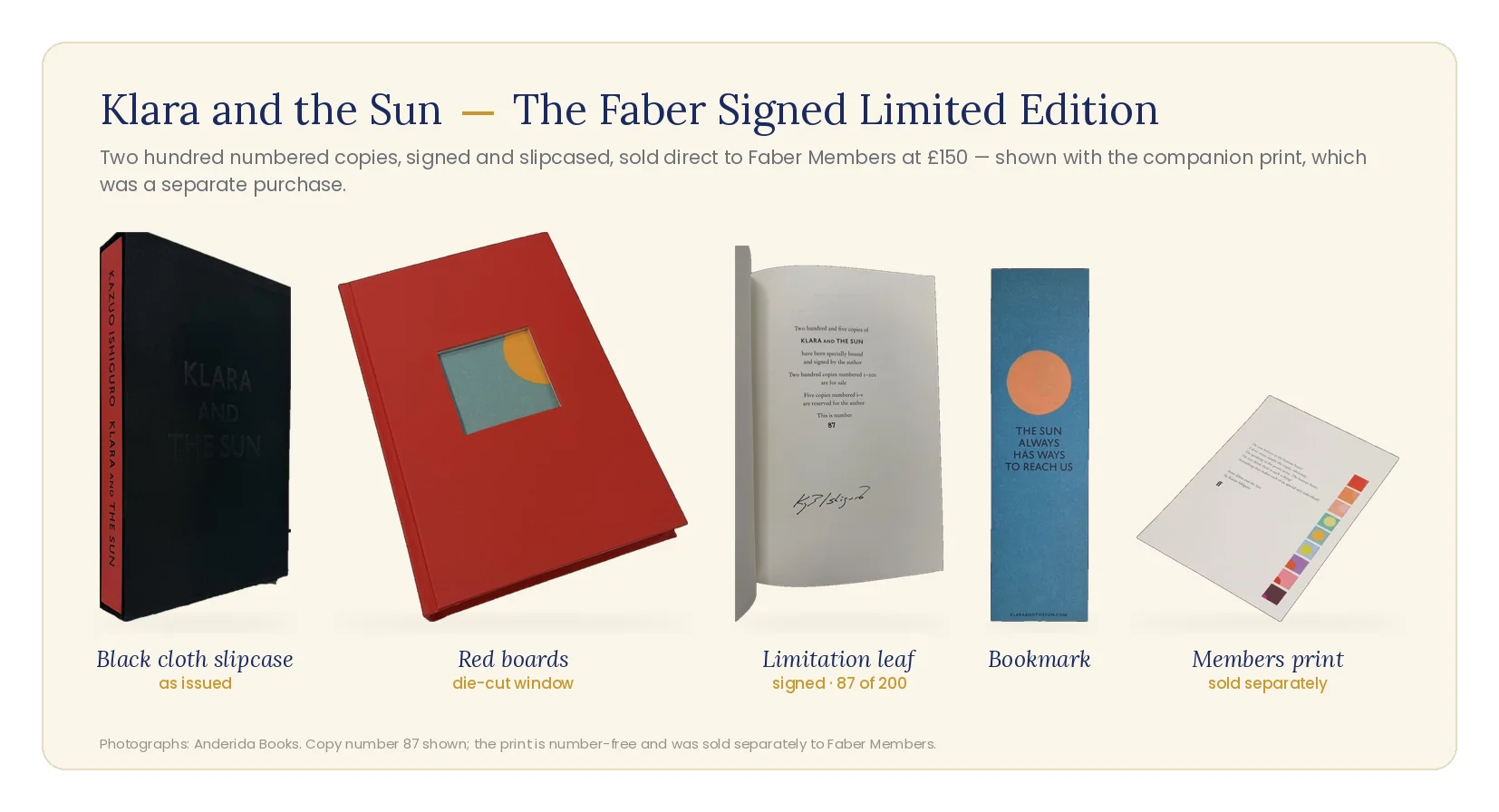
- ISBN 9780571364893 — a distinct ISBN from every trade state
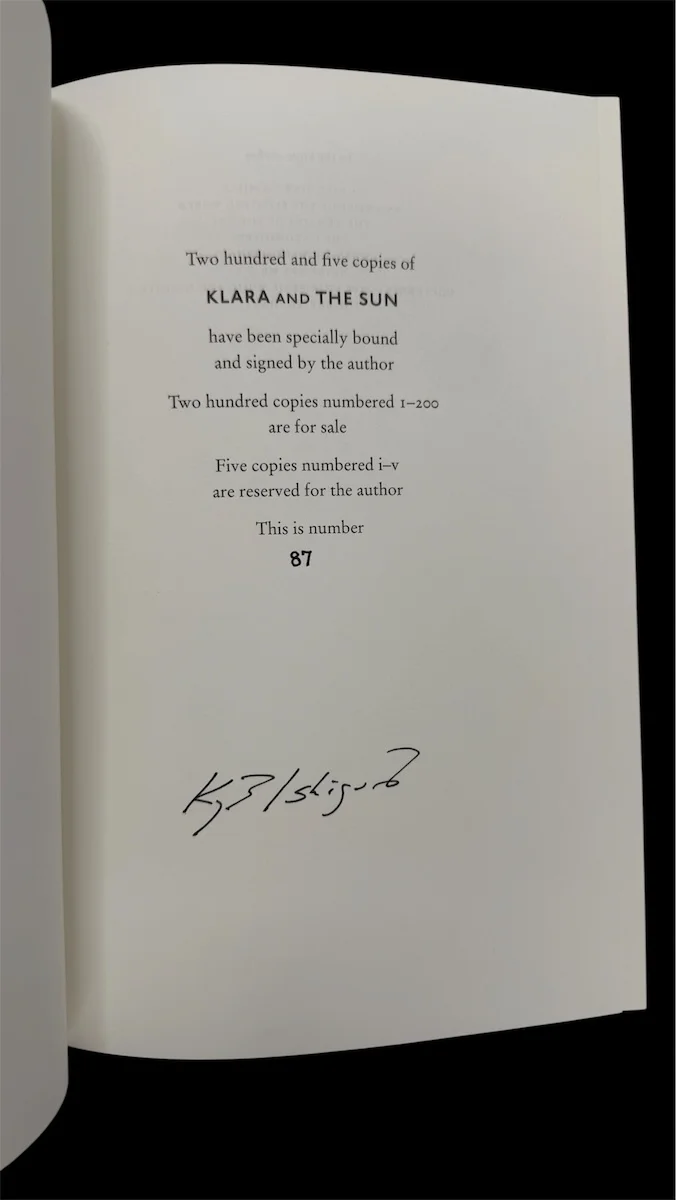
- 205 copies specially bound and signed, of which 200 numbered 1–200 are for sale and five, numbered i–v in roman numerals, are reserved for the author
- Signed by Kazuo Ishiguro on the limitation leaf, beneath the limitation statement
- Red paper-covered boards with a die-cut window to the front board, revealing the sun motif printed on the front endpaper
- Title embossed in black on the spine
- Housed in a rigid slipcase, and issued wrapped in brown paper with the numbered label affixed to the wrapper
- Issued at £150, sold direct to Faber Members rather than through the trade
- Dispatched from 5 March 2021, three days after publication
- Oversubscribed and sold out before publication day
The brown paper, and what it does and does not carry. Faber's launch-day description states that the book was "housed in a rigid slipcase and wrapped in brown paper, with numbered label affixed," and an unopened copy examined for this guide confirms it: still in the brown paper Faber uses for most of its direct sales, #17 clearly marked on the wrapper.
The book is also numbered internally. A limitation leaf photographed from an opened copy reads:
Two hundred and five copies of KLARA AND THE SUN have been specially bound and signed by the author Two hundred copies numbered 1–200 are for sale Five copies numbered i–v are reserved for the author This is number 87
with Ishiguro's signature beneath. So the wrapper label is a duplicate of the internal number rather than its sole carrier, and a copy separated from its wrapper is emphatically not an unnumbered copy. An earlier version of this guide warned that it might be; that warning was wrong, and is withdrawn.
Three things follow that are still worth knowing:
- The wrapper label and the limitation leaf should agree. A mismatch means the book and its wrapping have been separated and recombined, whether carelessly or otherwise. It is a cheap check and nobody makes it.
- "As issued, unopened in the original numbered wrapper" remains the top state — not because the number would otherwise be lost, but because it is unimprovable, effectively unfakeable, and its population only shrinks. The market does not currently price it separately.
- Five copies numbered i–v exist outside the numbered run, reserved for the author. If one ever reaches the market it is the rarest state of this book by a wide margin, and it should be described in roman numerals — a copy offered as "i/v" is not a mis-typed "1 of 5".
The Faber Members print — a separate collectable, in two states
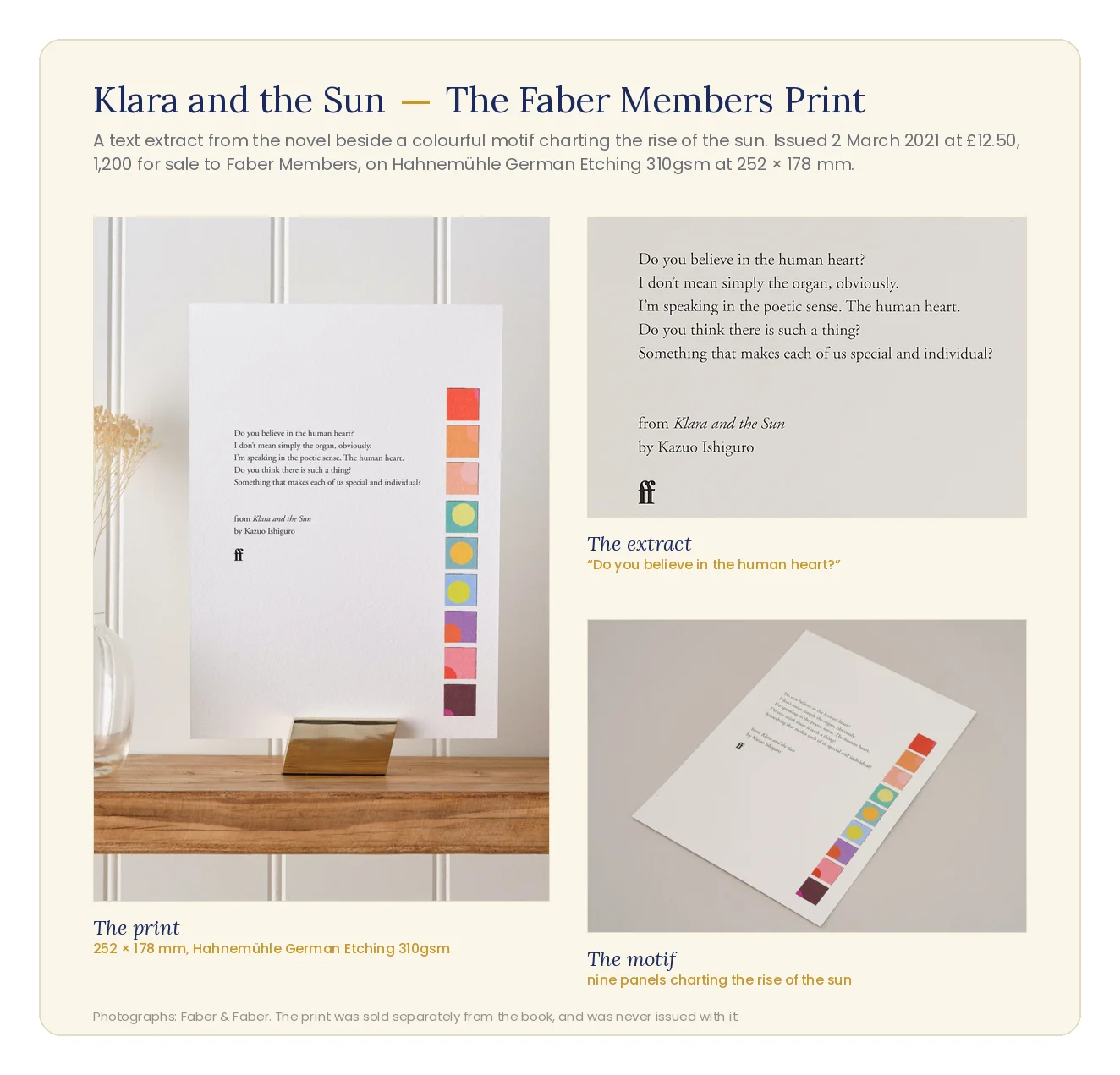
Copies of the limitation are frequently offered "with the Faber Members art print," and the assumption across the trade is that the print was issued with the limited edition. It was not. Nor, as an earlier version of this article suggested, was it a free premium attached to the signed trade offer. It was a third thing, sold separately, in its own limitation.
Faber's Members mailing of 26 February 2021 announced it in terms that leave no ambiguity:
"We are thrilled to announce a new limited-edition Members print (pictured above) that will be available for purchase, alongside main and limited-edition copies of the book. The prints will be priced at £12.50, are limited to a run of 1200 for sale in the UK and will be available on a first come, first served basis when they go on sale on Tuesday."
Faber's launch-day mailing of 2 March 2021 then set out the full specification, and it contains the single most interesting fact about this print.
| Image | A text extract from the novel, with artwork taken from the endpapers |
| Process | Digital print — Faber's own description, notwithstanding that the house category is "letterpress prints" |
| Stock | Hahnemühle German Etching, matte fine art, 310gsm, 100% alpha-cellulose |
| Dimensions | 252mm × 178mm |
| Issue price | £12.50 |
| For sale | 1,200, Faber Members only, UK addresses only |
| Retained | A further 100 copies, not for sale |
| Earlier state | 500 copies, different paper stock and different printing process, never individually sold |
| On sale | 2 March 2021, first come first served |
| Packaging | Compostable cellophane sleeve inside a card envelope |
So the print exists in two distinct states, and the trade does not know it. Faber's own footnote is unambiguous: "Previously, five hundred copies of the artwork were produced (using a different paper stock and printing process); these copies of the artwork were not made available for individual purchase and there will be no reprints made."
That makes an earlier 500-copy state on unidentified stock, produced by a different process and never sold — presumably distributed promotionally — and a later state of 1,300 (1,200 offered plus 100 retained) on Hahnemühle German Etching. Total artwork copies: 1,800, with no reprints ever.
The collecting consequences are worth stating plainly. The commonly quoted limitation of "1,200" describes sale copies of the second state only, not the print run. And the scarcer object by some margin is the first state — 500 copies, never purchasable, and identifiable only by its stock and printing. Anyone holding a Klara print that is not on 310gsm Hahnemühle German Etching may well have the rarer of the two and no way of knowing it from the published record. That is exactly the sort of distinction that goes unrecognised for a decade and is then obvious to everyone.
It also settles the process question raised by earlier descriptions: Faber calls the sale state a digital print, whatever the shop category is named.
And then the limitation stopped meaning anything
Here the story takes a turn that no collector should discover after paying for one.
As of August 2026 the print is still on sale from Faber, at £6.25 — half its issue price — under product ISBN 9780571370252. The listing carries no limitation statement at all.
So a "limited edition of 1,200, first come first served" has, five and a half years later, neither sold out nor held its price. Two readings are possible and the published record does not separate them:
- The stock is the original second state, unsold and now discounted. In which case the 1,200 was never a constraint — demand simply never reached it, and the word "limited" described an intention rather than a scarcity.
- Or Faber has printed more, which would sit awkwardly against the 2021 undertaking that "there will be no reprints made."
Either way the practical answer is the same, and it is worth stating bluntly.
The print has no secondary market and should command no premium. It is available new, from the publisher, at half what the original buyers paid. Anyone offered a book "with the Faber art print" at a meaningful uplift is being charged for something still in the shop — and any valuation of the second state above £6.25 is a valuation of nothing.
The first state is the one that matters. Five hundred copies, a different paper stock and a different printing process, never offered for individual sale, and no reprints of that state. Against a second state you can still buy at will, the gap between them is now the whole story. Anyone holding a Klara print that is not on 310gsm Hahnemühle German Etching may well have the only version of this object that is genuinely scarce — and nothing in the published record would tell them so.
Three further points for the record:
- Any book offered "with the print" is two purchases combined, whether by the original member or by a later dealer. The pairing reflects who bought what on the day, not how Faber issued anything.
- A limitation and a print with matching provenance — bought together by the same member on publication day — remains an attractive unit for its history. It is not a published unit, and its value sits in the book.
- Faber Members copies also circulate with other launch ephemera, bookmarks and press cards among them, which are pleasant but carry no bibliographical weight.
The US and Canadian first editions
- Alfred A. Knopf, New York, 2021, ISBN 9780593318171
- Octavo, publisher's cloth, dust jacket designed by John Gall
- Signed copies are almost universally tipped-in leaves or publisher's bookplates, not signed directly to the book
- Knopf Canada issued both hardback and softcover states, again with tipped-in signed leaves
A Faber softcover was also signed on a bespoke Klara & The Sun bookplate for certain retail channels. Collectors who insist on ink-to-page signatures should treat the entire North American signed market as a lower tier — not fraudulent, simply a different and more abundant product.
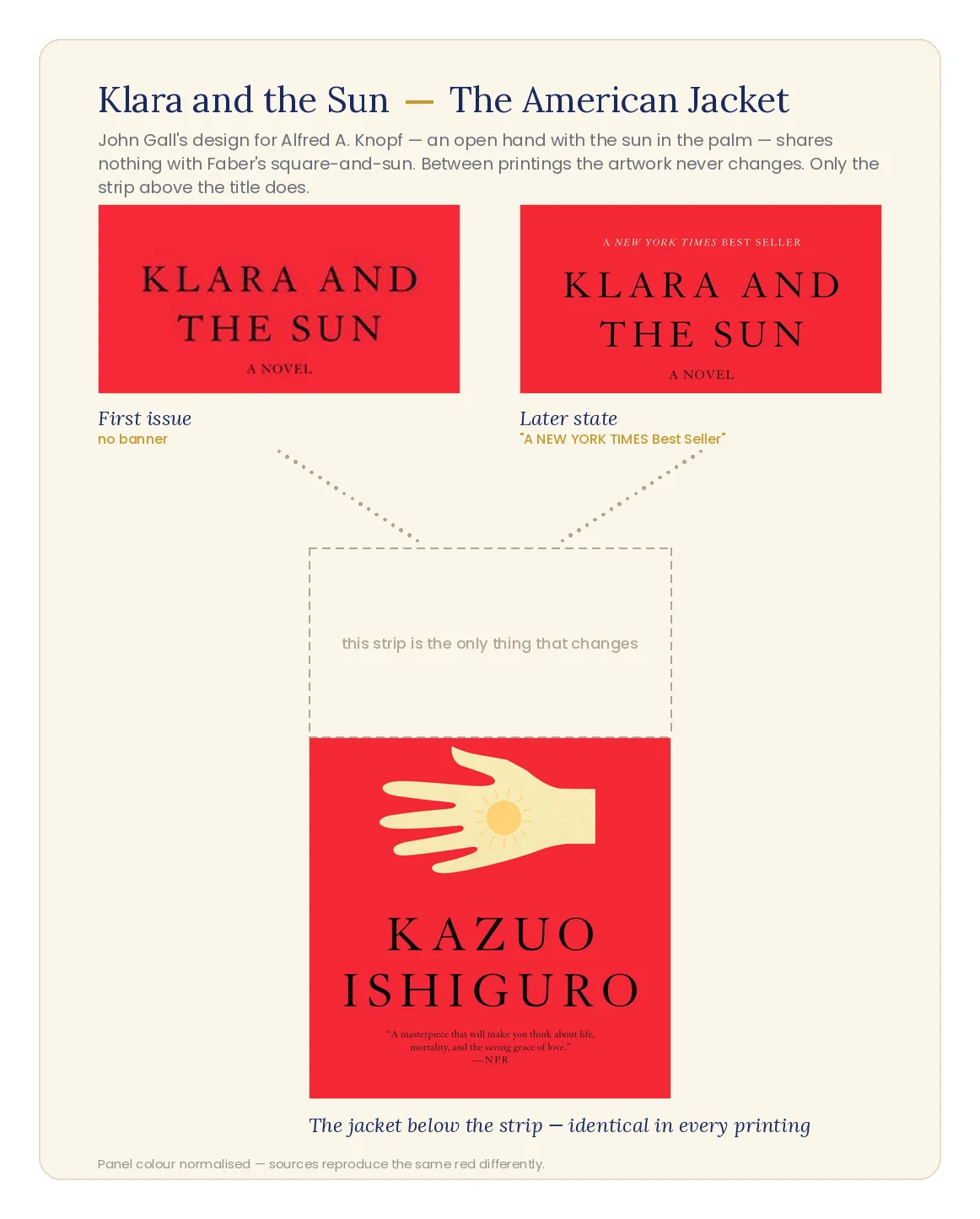
The American cover is a different design entirely. Where Faber went with Adlington's square-and-sun window, the US edition — credited to John Gall, Knopf's creative director — uses an open hand with a small radiant sun set in the palm, in cream on a warm red-orange ground, the title above and the author's name below. It is a striking piece of work in its own right and, unusually, it lands on almost exactly the same colour as the British jacket while sharing none of its geometry. Transatlantic divergence like this is entirely normal — US and UK houses commission separately, and each is designing for its own market — but it does mean a collector assembling both sides of the Atlantic is acquiring two genuinely different objects rather than one book twice.
The bestseller banner is your fastest first-printing test. The hand artwork itself runs unchanged from the Knopf hardback first issue through to the Vintage International trade paperback (ISBN 9780593311295, 1 March 2022) — the design was not reworked between them. What does change is the top of the cover. Later states carry a "NATIONAL BESTSELLER" flash above the title; that banner is added only once the book has become a bestseller, so:
A jacket showing "NATIONAL BESTSELLER" is, by definition, not a first printing. A first-issue Knopf jacket carries the title straight to the top of the panel, with the hand below and no bestseller flash anywhere on it.
Because the artwork is otherwise identical, that strip along the top is often the only thing distinguishing a first-printing jacket from a later one in a listing photograph — check it before you check anything else, then confirm against the number line.
One condition note specific to the American copies. Many signed US copies carry a round gold "SIGNED COPY" sticker applied to the jacket front. Leave it where it is. These stickers bond firmly to laminated jackets and routinely lift the coating or tear the paper when peeled, turning a fine jacket into a defective one in a couple of seconds. Note also that the sticker is a publisher or retailer device, not evidence in itself — it tells you what the shop believed, and the signature inside is what you actually verify.
The Folio Society illustrated edition (2025)
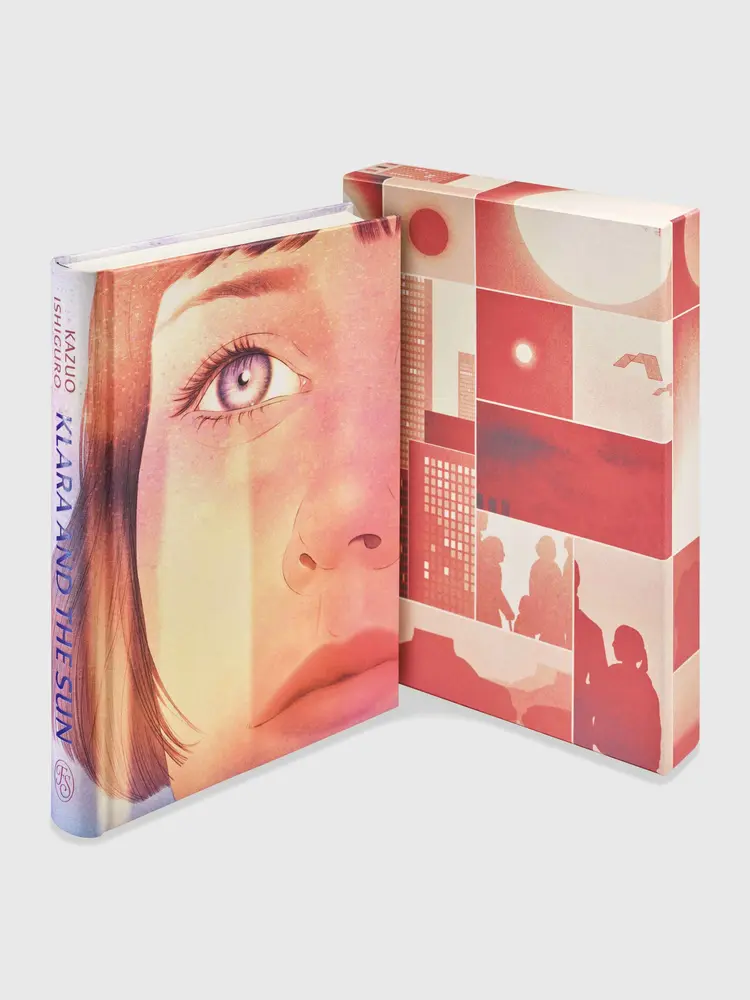
Four years after publication, The Folio Society issued the first illustrated Klara and the Sun, published 16 September 2025:
- Illustrated by Isabel Seliger — seven colour illustrations including two double-page spreads
- Printed and blocked cloth binding, pearlescent metallic endpapers, iridescent foiled page edges, pearlescent metallic printed slipcase
- 288 pages, 9 × 6¼ inches, set in Arno Pro with Linex Sans display
- Standard edition issued at US$110
- Signed edition limited to 100 copies, signed by Ishiguro, issued at £185 — now sold out
The 100-copy signed Folio state is the second-scarcest configuration of this book in existence, behind only the Faber 200. It is not a first edition and never will be, which caps its ceiling relative to the Faber limited — but as a production object it is arguably the more beautiful book, and 100 copies is 100 copies.
The 2026 film tie-in — for completeness, not for the shelf
Ahead of the film's release, Faber has announced a film tie-in paperback: ISBN 9780571396627, 352 pages, £9.99, published 24 September 2026. Vintage issues an equivalent in the United States (9798217007257) and Penguin Random House Canada another (9781039057869).
It abandons the Adlington design completely. In place of the square and the sun there is a photographic cover in the current adaptation idiom: a teal ground, a young woman in profile before a large pale sun, landscape imagery — a skyline, a car, a barn, fields — set inside the sun's disc, the title and author in yellow, and a "NOW A MAJOR MOTION PICTURE" roundel top right.
It is included here for completeness and to be recognised, not acquired. Tie-in editions are printed in enormous numbers against a film's release window, they carry no edition points worth the name, and they have never in the modern era developed a secondary market. Its collecting significance is entirely negative: to know it on sight and pass over it.
There is one indirect consequence worth noting. The tie-in draws a line under the Adlington livery on new printings, which makes the 2021–25 run of square-and-sun jackets a closed set. Closed sets are easier to collect deliberately, and tend to be looked back on more fondly than they were looked at.
A note on Goldsboro Books
Goldsboro is normally the first place a UK collector looks for a numbered exclusive on a title of this profile. For Klara and the Sun, no Goldsboro-numbered exclusive appears anywhere in the current secondary-market record. Goldsboro supplied signed first editions of the standard Faber issue, but the numbered-exclusive slot for this book was occupied by Faber's own 200-copy limitation. Do not pay a premium for a copy described as a "Goldsboro edition" without a stated limitation page — you are almost certainly being offered a signed trade first.
Identification: Telling the States Apart
Everything above explains why so many versions of this book exist. This section is the practical consequence: how to establish, from a book in the hand or a photograph on a screen, exactly which one you are looking at. Four tests, in the order of how quickly they can be applied.
1. The copyright page — the definitive test
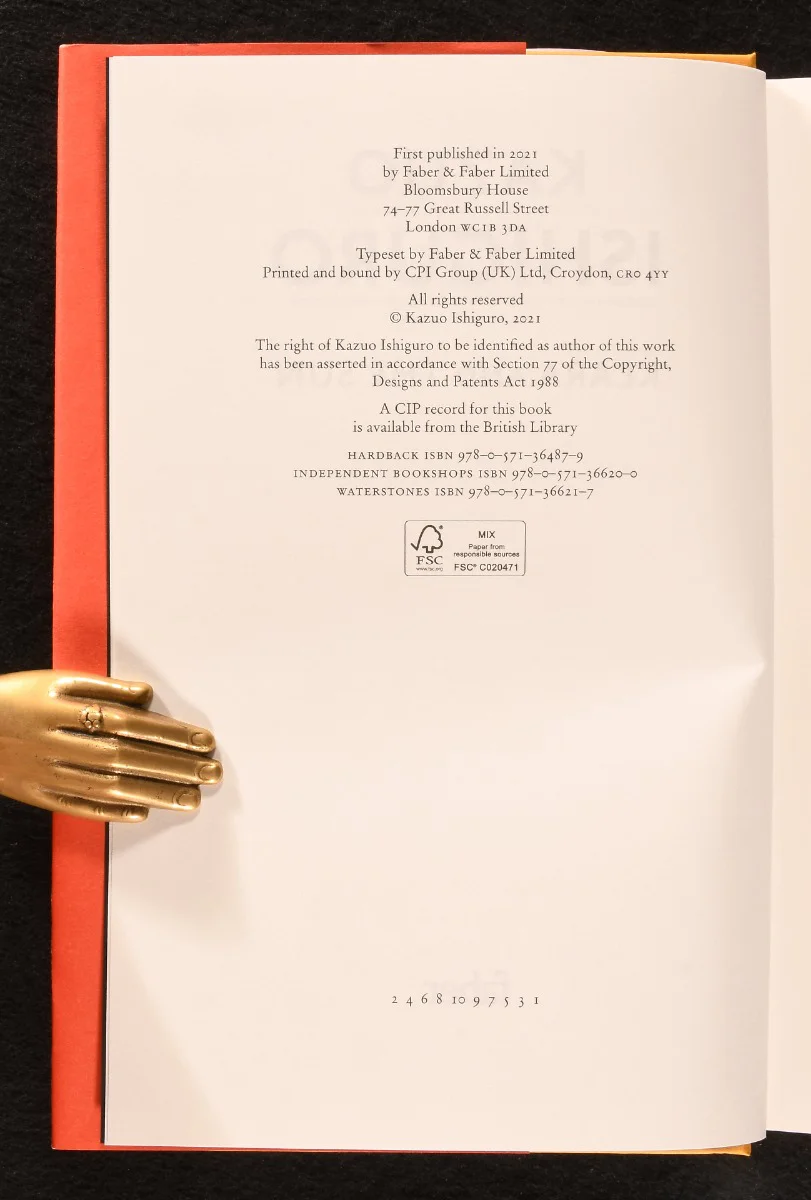
UK (Faber). The copyright page of the first printing reads First published in 2021 by Faber & Faber Limited, Bloomsbury House, 74–77 Great Russell Street, London WC1B 3DA, with printing by CPI Group (UK) Ltd, Croydon, and carries the number line:
2 4 6 8 10 9 7 5 3 1
The terminal 1 is the point: present means first printing, absent means not.
A practical warning about finding it: the number line is set at the foot of the page, well below the FSC mark and separated from the imprint block by a wide band of white space. Photographs of the copyright page — including most of those in dealer listings — are usually cropped to the text and miss it entirely. If a seller's photograph shows the three ISBNs but no number line, that is almost always the framing rather than the book. The jacket should be unclipped, showing £20.00.
The copyright page also settles the variant question by itself — and this is the single most useful identification point in this article. Faber printed all three UK ISBNs on it:
| Line as printed | ISBN | State |
|---|---|---|
| HARDBACK ISBN | 978-0-571-36487-9 | Standard trade issue |
| INDEPENDENT BOOKSHOPS ISBN | 978-0-571-36620-0 | Indies Edition (turquoise jacket) |
| WATERSTONES ISBN | 978-0-571-36621-7 | Waterstones exclusive (printed edges) |
Two things follow. First, it is documentary proof that the three states were planned and produced as one simultaneous issue rather than improvised afterwards — Faber set the type knowing all three would exist. Second, and practically: any copy whose copyright page carries these three lines belongs to the March 2021 first-edition family, whichever jacket it wears. You can authenticate the group from the book itself, without reference to a retailer, a dealer's description, or a jacket that may have been swapped.
It follows that the copyright page is also worth checking on a suspected Summer Edition (9780571373062), which did not exist when this setting was made. I have not examined a copy of that issue's prelims, so I offer this as the check to make rather than as a stated point of difference — but it is the first place I would look.
A note on the window — printed, not cut. The trade jacket's square is flat-printed artwork. Laid out flat, the dust jacket is a single unbroken printed sheet; the slight recessed look in photographs of the jacketed book is an illusion of the design and the lighting, nothing more. The die-cut window is a feature of the Faber signed limited edition alone, where it is cut through the front board — that edition has no dust jacket at all — to reveal the sun printed on the front endpaper beneath. If a seller describes a jacketed trade copy as having a cut-out window, they have confused the two editions.
US (Knopf): 9780593318171, first printing, John Gall jacket, no bestseller banner, no price-clipping.
2. The livery — what the outside tells you
| Livery | ISBN | Issue | First edition? |
|---|---|---|---|
| Dark orange jacket, plain edges | 9780571364879 | March 2021 trade | Yes |
| Dark orange jacket, pictorial edge (sage sky + yellow sun) and twelve-panel sun endpapers | 9780571366217 | March 2021 Waterstones exclusive (signed and unsigned) | Yes |
| Turquoise jacket, magenta boards | 9780571366200 | March 2021 Faber Indies Edition, signed | Yes |
| Flat yellow edge, no design | 9780571373062 | "Exclusive Summer Edition", 9 June 2021 | No — later reissue |
| Red boards, die-cut window, slipcased | 9780571364893 | Faber Members signed limited, 1 of 200 | Yes |
3. The fore-edge and endpapers — for the Waterstones issues
The two tests that separate the March exclusive from the June reissue are described in full under The Design above, and reduce to two questions you can ask of any photograph:
- Is there a picture on the fore-edge? A sage blue-grey sky carrying a yellow sun disc means 9780571366217, the March first-edition exclusive. A flat yellow edge with no design means 9780571373062, the June reissue.
- Is there a twelve-panel sun grid on the endpapers? If so it is the March exclusive. The trade issue has plain endpapers, and the June reissue is not described as having decorated ones.
Either test alone is sufficient. Both together leave no room for argument.
The Collector's Guide
Condition is not negotiable on a modern first
This is a 2021 book that sold in enormous numbers. There is no scarcity argument for accepting compromised condition. Specifically:
- Reject bumped corners, spine lean, foxing to the top edge, and any jacket rubbing at the head of the spine
- Reject remainder marks entirely
- On the Waterstones exclusive, inspect the sprayed edges under raking light. Sprayed edges scuff, and worse, they can offset onto the endpapers or transfer where copies were shelved tightly. A scuffed spray is the difference between a £175 copy and a £60 copy
- On the Faber limited, the slipcase is part of the book. Sellers routinely grade the book "fine" and the slipcase "near fine" for a single mark to the opening edge — and that single mark is worth real money at this level
- On the Faber limited, check the die-cut window for creasing or delamination at the cut edge, which is the natural failure point of that construction
Signature provenance
For UK copies, the signature should be in ink, directly to the half-title or title page. A small subset carry a pre-publication date in Ishiguro's hand — these are the most desirable signed trade copies and currently trade at roughly double an undated signed copy. For US and Canadian copies, expect a tipped-in leaf or bookplate; verify the leaf is original to the book and not a later insertion.
Ishiguro is a living Nobel laureate who still signs, so signature scarcity is not the driver here — edition scarcity is.
What to prioritise, in order
- Faber Members signed limited, 1 of 200 (9780571364893), ideally as issued and unopened in its numbered brown paper wrapper; failing that, fine in fine slipcase with the wrapper retained and its label matching the limitation leaf. The only genuinely scarce state.
- Folio Society signed, 1 of 100, as issued in slipcase, unread. Scarce, beautiful, but not a first edition.
- Signed Waterstones exclusive, fine, with unmarked sprayed edges.
- Signed Indies Edition (turquoise jacket) — currently the best value-per-unit-of-scarcity in the whole group.
- Signed standard UK first, ink to half-title, ideally dated.
- Everything else is a reading copy with a nice jacket.
The film question
The adaptation arrives in October 2026, and the publishing machinery around it is already turning: Faber's tie-in paperback (9780571396627) is announced for 24 September 2026, with US and Canadian equivalents alongside it.

Expect three effects, in this order. A short pre-release bump in asking prices across all signed states, which is already visible in the figures below. A flood of tie-in stock, which is noise — it depresses nothing and it appreciates never, but it does make casual searching harder, because listings for the scarce states now compete with thousands of £9.99 paperbacks under the same title. And then, if the film is well received, a durable widening of the buyer pool for the states that are genuinely scarce.
The asymmetry is the thing to hold on to. If the film underperforms, the trade firsts give back the bump; the 200-copy limitation does not, because its price was never a function of the film in the first place. That is the recurring lesson of adaptation-driven markets, and the reason to buy scarcity rather than momentum in the weeks around a release.
Secondary Market Values
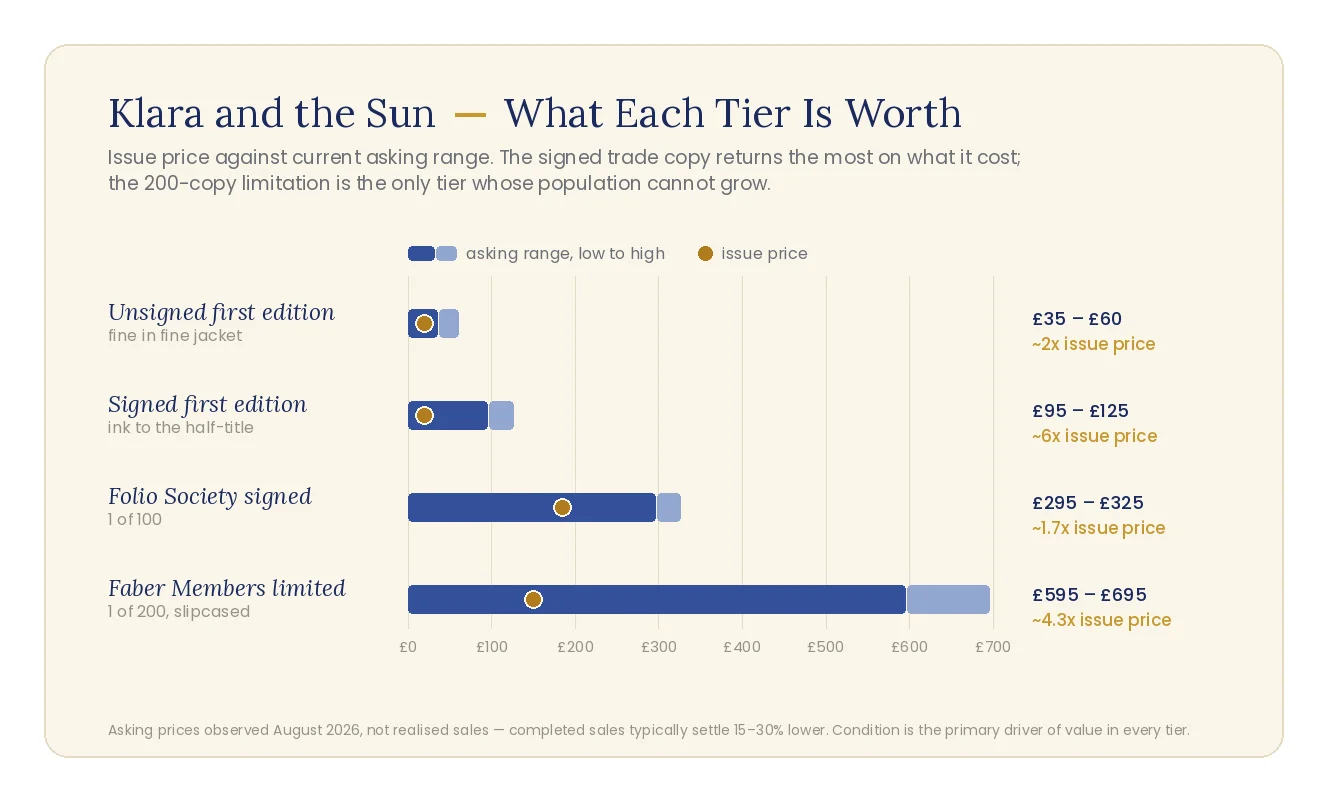
The figures below reflect asking prices observed on AbeBooks, eBay and specialist dealer sites in August 2026. They are asking prices, not realised prices; completed sales typically settle 15–30% below dealer asks, particularly on the mid-tier signed material where supply is deep.
Condition is the primary driver of value in every row of this table, and all figures are approximate. A near-fine copy of any configuration below is worth a fraction of a fine one, and on this title — with its sprayed edges, die-cut boards and slipcases — condition variance is unusually wide.
Comparative table by configuration
| Configuration | ISBN | Population | Typical asking range |
|---|---|---|---|
| UK Faber first/first, unsigned, near fine | 9780571364879 | Very large | £18 – £45 |
| UK Faber first/first, unsigned, fine/as-new in fine jacket | 9780571364879 | Very large | £35 – £60 |
| Waterstones exclusive, unsigned, fine | 9780571366217 | Large | £40 – £75 (thin listing data; inferred from the signed spread) |
| US Knopf first/first, unsigned | 9780593318171 | Very large | £45 – £95 |
| US/Canada Knopf, signed (tipped-in leaf or bookplate) | 9780593318171 | Large | £47 – £122 |
| Indies Edition, signed, turquoise jacket | 9780571366200 | Moderate | £80 – £90 |
| "Exclusive Summer Edition", yellow edges — June 2021 reissue | 9780571373062 | Trade reissue | £15 – £30 |
| UK Faber first/first, signed to half-title | 9780571364879 | Moderate | £95 – £125 |
| UK Faber first/first, signed and pre-publication dated | 9780571364879 | Small | £175 – £195 |
| Waterstones exclusive, signed, sprayed edges fine | 9780571366217 | Moderate | £175 – £200 (US listings to ~$250) |
| Folio Society standard illustrated edition | — | Trade | £85 – £110 (issued US$110) |
| Folio Society signed limited, 1 of 100 | — | 100 | £295 – £325 (issued £185) |
| Faber Members signed limited, 1 of 200 numbered | 9780571364893 | 200 | £595 – £695 (issued £150) |
The three-way comparison
For the direct comparison requested — a clean first edition, first printing against its signed and limited siblings:
| Clean unsigned FEFP | Signed FEFP | Limited FEFP (1 of 200) | |
|---|---|---|---|
| Issue price (2021) | £20 | £20 | £150 |
| Typical fine-copy ask (Aug 2026) | ~£40 | ~£120 | ~£640 |
| Return on issue price | ~2× | ~6× | ~4.3× |
| Multiple vs. clean FEFP | 1× | ~3× | ~16× |
| Population | Tens of thousands | Low thousands | 200 |
That table contains a result most collectors get wrong, so it is worth sitting with. On pure return against issue price, the signed trade first has outperformed the numbered limitation — roughly 6× against roughly 4.3× — because the signed trade copies were sold at the ordinary £20 retail price while the limitation asked £150 up front. Anyone who queued for a signed Waterstones or independent bookshop copy at cover price made the better percentage trade.
But percentage return is not the whole argument, and here is why the limitation is still the serious position:
- Scarcity does not decay. There are 200 numbered copies and there will only ever be 200. The signed trade population runs to the low thousands and its 6× was earned mostly in the first eighteen months; it has been broadly flat since.
- Liquidity at the top is thinner but the floor is firmer. Signed trade copies compete with dozens of near-identical listings and are priced by the most impatient seller in the market. The limitation is priced by whoever actually has one.
- The £150 barrier did the work. It suppressed speculative buying at issue, which is precisely why so few copies churn now.
Between March 2021 and August 2026 the numbered limited edition has appreciated steadily in a period when the wider modern-firsts market has been flat to soft — the behaviour of scarcity rather than of hype. The signed trade copies delivered a sharper early spike and have since gone quiet. If you are buying today rather than in 2021, that distinction is the one that matters: the entry price on the signed trade material already reflects its run.
The honest caveat: the Faber 200 is now a £600-plus book with an eventual buyer pool measured in low hundreds. It is illiquid. If you need to sell in a hurry you will take a haircut. The signed Waterstones and independent bookshop copies are far more liquid at their level, which is a real if unglamorous virtue.
Kazuo Ishiguro: The Wider Collection
Klara and the Sun sits near the end of an unusually short and unusually consistent bibliography. Ishiguro has published nine books of fiction in more than forty years, which is itself part of why the early titles are so keenly collected.
| Title | UK first | Notes for collectors |
|---|---|---|
| A Pale View of Hills | Faber, 1982 | The debut, and comfortably the scarcest book in the bibliography. A modest first printing by an unknown author; fine jacketed firsts are the four-figure item every serious Ishiguro collection is built around. Adapted for film by Kei Ishikawa, premiered at Cannes in 2025. |
| An Artist of the Floating World | Faber, 1986 | Whitbread Book of the Year; Booker shortlisted. Still scarce in fine state, and the natural second acquisition after the debut. |
| The Remains of the Day | Faber, 1989 | Booker Prize winner. The blue-chip title. Larger printing than the first two but overwhelming demand; the Merchant Ivory film keeps a permanent floor under it. |
| The Unconsoled | Faber, 1995 | Divisive on publication, increasingly reappraised. Undervalued relative to its scarcity. |
| When We Were Orphans | Faber, 2000 | Booker shortlisted. Large printing; a common signed copy. |
| Never Let Me Go | Faber, 2005 | Booker shortlisted; Time's best novel of 2005. Very large printing, so unsigned firsts are cheap — but it is his most widely read book and signed fine copies have quietly firmed up. |
| Nocturnes | Faber, 2009 | His only short-story collection, and the outlier in an otherwise novel-length bibliography. Consistently the least chased of his mature books, which is precisely why it is worth watching. |
| The Buried Giant | Faber, 2015 | Post-Never Let Me Go, pre-Nobel. Large printing; the weakest performer of the mature novels on the secondary market. |
| Klara and the Sun | Faber, 2021 | The subject of this guide. First novel after the Nobel; the richest field of collectable states in the bibliography. |
| The Summer We Crossed Europe in the Rain: Lyrics for Stacey Kent: Lyrics for Stacey Kent** | Faber, 2024 | Illustrated by Bianca Bagnarelli. A slipcased limited edition was issued double-signed by Ishiguro and Bagnarelli — a small, attractive and still-affordable limitation that most Ishiguro collectors have not yet caught up with. |
| Miss Lambert Steps Aboard Danger | Announced for 9 March 2027 (Knopf US; Faber UK) | A 1930s London spy caper, described by Knopf as "part caper, part spy novel, part Wodehousean comedy of manners." Watch the pre-order window. Klara and the Sun proved that Faber will produce a numbered limitation for an Ishiguro novel and that it will sell out before publication. |
He has also written directly for the screen: The Saddest Music in the World (2003), The White Countess (2005), and Living (2022), the latter earning him an Academy Award nomination for Best Adapted Screenplay.
The Faber Members thread
One collecting avenue deserves separating out, because Klara and the Sun demonstrated how productive it is. Faber Members, the publisher's own subscription scheme, issues member-only states of its major titles direct to subscribers — the 200-copy Klara limitation being the most valuable example to date, but not an isolated one. Never Let Me Go has appeared as a paper-wrapped Faber Members Edition (9780571369157), and Faber has continued to produce anniversary and members' states across the Ishiguro backlist, including a signed twentieth-anniversary issue of Never Let Me Go in 2025.
For a collector building Ishiguro seriously, the lesson from 2021 is simple: the scarcest state of the book was never available in a bookshop. It went to people who had subscribed before publication was announced. If Faber runs a comparable limitation for Miss Lambert Steps Aboard Danger in March 2027 — and the Klara precedent says it will — membership is the access route, and it needs to be in place beforehand.
The strategic view for a portfolio
If you are buying Ishiguro as an investment rather than as a reader, the ranking has been stable for a decade and Klara and the Sun does not disturb it: A Pale View of Hills first, The Remains of the Day second, An Artist of the Floating World third. What Klara and the Sun offers is something the early books cannot — a scarce, verifiable, fixed-population state that you can still buy today, in as-new condition, from a dealer, without provenance anxiety. Two hundred copies of a Nobel laureate's post-Nobel novel, signed and numbered, in a purpose-designed binding, is a rational position. Ten unsigned trade firsts bought against a film release is not.

Snap Facts: Kazuo Ishiguro
- Born 8 November 1954 in Nagasaki, Japan. His family moved to Guildford, Surrey, in 1960, when his father — an oceanographer — took up a post with the National Institute of Oceanography. The move was intended to be temporary.
- He wanted to be a musician first. As a teenager he sent demo tapes to record companies and pursued a career as a singer-songwriter before turning to fiction.
- He worked as a grouse beater for the Queen Mother at Balmoral in 1973.
- He studied creative writing at the University of East Anglia, where his tutors were Malcolm Bradbury and Angela Carter.
- Granta named him one of its Best of Young British Novelists twice — in both 1983 and 1993.
- He wrote The Remains of the Day in four weeks. In 1987 he and his wife instituted what they called "the Crash": a month in which he was released from all correspondence, appointments and domestic obligation and wrote from 9am to 10.30pm. The Booker Prize followed in 1989.
- He writes song lyrics for the jazz singer Stacey Kent. His lyrics appear on her Grammy-nominated album Breakfast on the Morning Tram (2007), and the 2024 book The Summer We Crossed Europe in the Rain: Lyrics for Stacey Kent collects that work.
- Klara and the Sun began life as a children's picture book. He tried the story out on his daughter Naomi Ishiguro — herself now a published novelist — who told him it was far too upsetting for children. He turned it into a novel for adults instead.
- Nobel Prize in Literature, 2017, awarded for novels "which, with great emotional force, have uncovered the abyss beneath our illusory sense of connection with the world."
- Knighted in 2018 for services to literature.
All prices quoted are approximate asking prices observed in August 2026 and are offered as guidance only. Condition is the primary driver of value in every configuration discussed above. Collectors should satisfy themselves as to edition points, signature authenticity and condition before purchase.
Sources, References and Deductions
This guide makes a number of claims that correct or sharpen the published record. What follows sets out where each came from, and — as importantly — which statements are inferences rather than citations. Readers are invited to check the working.
Primary sources: the designer
- Pete Adlington, "Cover Design: Klara and the Sun," Faber Journal, 13 May 2021 (updated 7 March 2022). https://www.faber.co.uk/journal/cover-design-klara-and-the-sun/ — The designer's own account of the commission. Source for: the Paul Bacon "big book look" intention and Steven Heller's definition of it; Ishiguro's objection to an early route on grounds of its resemblance to the Japanese flag; the painterly re-execution; red approved with a typeface amendment; the colourway exercise supplying "the endpapers, the special editions, and the marketing campaign"; the turquoise colourway being used for the independent edition; the Waterstones edition keeping the original cover and taking printed edges carrying the window design; the endpaper panels being reused for the reveal poster; and the subsequent rejacketing of the eight-title backlist.
- Spine Magazine, interview with Pete Adlington. https://spinemagazine.co/articles/pete-adlington2 — Corroborating account. (This interview also attributes the colour explorations to Josef Albers' colour theory; that detail does not appear in Adlington's own Faber piece and has been omitted here rather than carried on a single secondary source.)
Primary sources: publisher and retailer
- Faber & Faber, "Klara and the Sun (Indies Edition)," 9780571366200. https://www.faber.co.uk/product/9780571366200-klara-and-the-sun/ — Establishes Indies Edition as Faber's own name for the turquoise-jacket state.
- Faber & Faber, "Never Let Me Go (Members Edition)," 9780571369157. https://www.faber.co.uk/product/9780571369157-never-let-me-go/
- Waterstones product records, consulted August 2026: standard hardback https://www.waterstones.com/book/klara-and-the-sun/kazuo-ishiguro/9780571364879 · exclusive edition https://www.waterstones.com/book/klara-and-the-sun/kazuo-ishiguro/9780571366217 · signed exclusive https://www.waterstones.com/book/klara-and-the-sun/kazuo-ishiguro/2928377047306 · Indies ISBN https://www.waterstones.com/book/klara-and-the-sun/kazuo-ishiguro/9780571366200 · Summer Edition https://www.waterstones.com/book/klara-and-the-sun/kazuo-ishiguro/9780571373062 — Source for the exclusive's stated features ("exclusive sprayed edges and endpapers"), the Summer Edition's "yellow sprayed edge," and the film tie-in's ISBN, price and 24 September 2026 date.
- Waterstones launch listing images for 9780571366217 — three product photographs: jacket front-on, the book angled to display the printed fore-edge, and the endpapers. The retailer photographing the edge deliberately is the basis for treating the pictorial edge as a documented feature rather than a dealer observation.
- Waterstones promotional video, 9 June 2021, captioned "Waterstones exclusive edition, out now," showing the Summer Edition's flat yellow edge.
- Waterstones, "An Exclusive Q&A with Kazuo Ishiguro on Klara and the Sun," by Anna Orhanen, 24 February 2021. https://www.waterstones.com/blog/an-exclusive-qanda-with-kazuo-ishiguro-on-klara-and-the-sun — the promotional interview that is the likely origin of the persistent "extra chapter" myth; roughly 3,500 words of questions and answers containing no fiction.
- The Folio Society, standard and signed editions of the 2025 illustrated edition, illustrated by Isabel Seliger. https://www.foliosociety.com/uk/klara-and-the-sun-signed-edition
- Alfred A. Knopf / Vintage / Penguin Random House Canada catalogue records for 9780593318171, 9780593311295, 9798217007257 and 9781039057869.
Archival sources
- Internet Archive, Wayback Machine, captures of the Waterstones listing for 9780571373062: 25 May 2021 (https://web.archive.org/web/20210525163645/https://www.waterstones.com/book/klara-and-the-sun/kazuo-ishiguro/9780571373062), showing "Coming soon / Awaiting publication" with a pre-order button; and 10 June 2021 (https://web.archive.org/web/20210610050725/https://www.waterstones.com/book/klara-and-the-sun/kazuo-ishiguro/9780571373062), showing "10+ in stock / Available."
Physical evidence examined
- Copyright page of a UK first printing — source for the number line 2 4 6 8 10 9 7 5 3 1, the printer (CPI Group (UK) Ltd, Croydon), and the three printed ISBN lines for HARDBACK, INDEPENDENT BOOKSHOPS and WATERSTONES.
- Dust jacket photographed laid flat — establishes that the trade jacket's window is printed artwork on an unbroken sheet, and that the die-cut window belongs to the limited edition alone.
- Fore-edge of a confirmed 9780571366217 copy — the sage blue-grey sky with yellow sun disc, from a dealer listing specifying that ISBN.
- The limitation leaf of the Faber limited edition, photographed from an opened copy (number 87) in a dealer listing — source for the full limitation statement, the five author's copies numbered i–v, and the signature's position on the limitation leaf. An unopened copy (number 17) supplied the wrapper evidence.
- Knopf first-issue jacket compared against a later state — establishing the "NATIONAL BESTSELLER" banner as a first-printing disqualifier and the artwork as otherwise unchanged.
- Faber colourway sheet — five mock-ups of the jacket, showing the trade and Indies liveries as siblings.
- Faber, "Klara and the Sun Art Print", product page for ISBN 9780571370252, consulted August 2026 — source for the print's continued availability at £6.25 and for the absence of any limitation statement on the current listing. https://www.faber.co.uk/product/9780571370252-klara-and-the-sun-art-print/
- Faber Members launch-day mailing, 2 March 2021, quoted from the recipient's copy — source for the print's full specification (image, digital process, Hahnemühle German Etching 310gsm, 252mm × 178mm, packaging), the 100 retained non-sale copies, the earlier 500-copy state on different stock by a different process, and the limited edition's brown-paper wrapper with numbered label affixed and dispatch from 5 March 2021.
- Faber Members mailing, 26 February 2021, quoted from the recipient's copy — source for the Members print's £12.50 issue price, its limitation of 1,200 for UK sale, its first-come-first-served availability, and the fact that it was sold separately from both the main and limited editions.
- The author's own collection records — acquisition data for the Faber Members editions, establishing the limited edition's £150 issue price and, from separate order numbers, that the Hahnemühle art print accompanied the signed trade offer rather than the limitation.
Market data
Asking prices were compiled in August 2026 from AbeBooks (aggregate listings and individual dealer records), eBay, and the sites of Anderida Books, Ulysses Rare Books, Raptis Rare Books, Zeitgeist Books, Rooke Books, Book Box London, Fine Book Cellar, Bonafide Collections and others named in the tables.
Secondary sources
Wikipedia (Klara and the Sun; Klara and the Sun (film); John Gall) for publication, awards, adaptation and biographical detail; Kirkus Reviews for the announcement of Miss Lambert Steps Aboard Danger (Knopf, 9 March 2027); Creative Boom for Isabel Seliger; contemporary coverage of the 2025 Cannes premiere of A Pale View of Hills.
Deductions, inferences and open questions
The following are reasoning, not citation. They are the claims to challenge first.
Firm inferences
- The Summer Edition is dated to on or about 9 June 2021. No publisher announcement of a date has been found. The date is triangulated from three independent records: the listing showing pre-order on 25 May, the promotional video captioned "out now" on 9 June, and the listing showing stock on 10 June.
- The "Published: 02/03/2021" line on Waterstones variant records is inherited work-level metadata, not a printing date. Deduced from the 25 May capture, which displays that line directly above "Awaiting publication" — a self-contradiction that only inherited metadata explains.
- The trade's inconsistent descriptions of the Waterstones fore-edge arise because the edge is pictorial rather than monochrome. Proposed as a hypothesis to explain "green" and "yellow" appearing as rival descriptions, then confirmed against a photograph of a confirmed copy.
- Waterstones product code 2928377047306 is not an ISBN. The number carries a valid EAN-13 check digit, but its leading 2 places it in the GS1 range reserved for retailer internal use, outside the 978/979 Bookland ranges.
Judgements and estimates
- That the signed Indies Edition is undervalued relative to the signed Waterstones exclusive is an editorial judgement from current asking spreads, not a market fact.
- Population figures beyond the stated limitations (200 and 100) are estimates. "Low thousands" of signed trade copies is an order-of-magnitude guess; Faber has published no signing figures.
- That signed trade copies have been "broadly flat" since roughly 2022 is inferred from current asking spreads against earlier observed prices, not from a tracked price series.
- All prices are asking prices, not realised prices. Completed sales typically settle materially below dealer asks.
Open questions
- Whether the print currently on sale is the original second state or a later printing is unresolved. Faber's 2021 copy stated there would be no reprints; the 2026 listing carries no limitation statement and a halved price. The two readings — unsold original stock, or a reprint contradicting the undertaking — cannot be separated from the public record, and the article states both rather than choosing.
- The Summer Edition's prelims have not been examined. Its copyright page cannot carry the three-ISBN setting, since 9780571373062 did not exist when that setting was made — but this is offered as the check to make, not as a verified point of difference.
- Faber's promotional renders of the exclusive show the jacket's sun as yellow, where copies show orange. Whether this reflects an early state, an idealised render, or colour shift in reproduction is unresolved; renders should not be used for colour matching.
- The figure on the 2026 film tie-in cover has not been identified from a citable source and is deliberately not named here.
- Faber's original issue prices for the Waterstones and Indies exclusives are recorded here at the £20.00 trade price on the evidence of retailer listings; no publisher price list has been consulted.
Image and text credits
All cover artwork, jacket and endpaper designs, product photography and promotional imagery reproduced in this article remain the copyright of their respective owners — principally Faber & Faber, Alfred A. Knopf, The Folio Society and Waterstones, together with the designers and illustrators named above. Quoted passages remain the copyright of their authors and publishers.
Everything is reproduced here solely for the purposes of identification, comparison and critical commentary, with attribution and without any claim of ownership. Composite images have been assembled from publisher and retailer sources for side-by-side comparison; no affiliation with, or endorsement by, any publisher or retailer is implied. Any rightsholder preferring an item to be removed or differently credited is welcome to get in touch.
Corrections made during preparation
In the interest of showing the working: an earlier draft of this article described the Indies Edition jacket as blue, following the near-unanimous usage of the trade. Adlington's own account gives it as turquoise, and the article was corrected. An earlier draft also weighed Faber's "letterpress prints" category against the Hahnemühle stock without resolving it; Faber's own launch-day copy calls the sale state a digital print. The Faber Members print went through two further corrections: an early draft treated it as an inclusion with the limited edition, a second draft as a premium attached to the signed trade offer, and Faber's own announcement of 26 February 2021 establishes that it was neither — a separately purchased print in its own limitation of 1,200. A late draft further warned that a copy separated from its brown paper wrapper might be effectively unnumbered; a photographed limitation leaf shows the book is numbered internally as well, and that warning was withdrawn. The errors originated in trusting secondary description over primary evidence — or, in the last case, in reasoning ahead of it — which is the failure mode this article exists to argue against.
A note on recording identifiers
Retailer product numbers validate as well-formed thirteen-digit codes, so nothing in your software will object if you file one in an ISBN field — and you will end up with a catalogue in which one physical book appears under two apparently legitimate identifiers. Keep the registered ISBN in its own field, and give every other identifier a labelled type of its own: retailer product number, Goodreads work or edition ID, dealer stock code. A note field is adequate for a shelf list, but a collection of any size wants each identifier tagged with what kind of identifier it is, so a new source can be added without disturbing the ones already there. Be aware, too, that not every such code announces itself — retailer-generated numbers are not always in the obvious 2-prefix range, and a made-up identifier in 978-form is far harder to spot. If an identifier appears in no bibliographic database and returns only that one retailer's page, treat it as an internal code until proved otherwise. None of this affects what a book is worth; it affects whether you can describe accurately what you own, which over a few thousand volumes matters just as much.
Disclaimer: Valuations are estimates based on recent secondary market activity and should be treated as guidance only. Market conditions change; always verify current prices with specialist dealers before buying or selling.
© 2026 thebook.buzz. Original content — all rights reserved. Reproduction without permission is prohibited.