
Collector's Insight
Collecting The Ocean at the End of the Lane: Neil Gaiman's Illustrated Edition Guide
How two illustrators — Dave McKean in 2013 and Elise Hurst in 2019 — turned a slim modern classic into one of Gaiman's most collectible titles
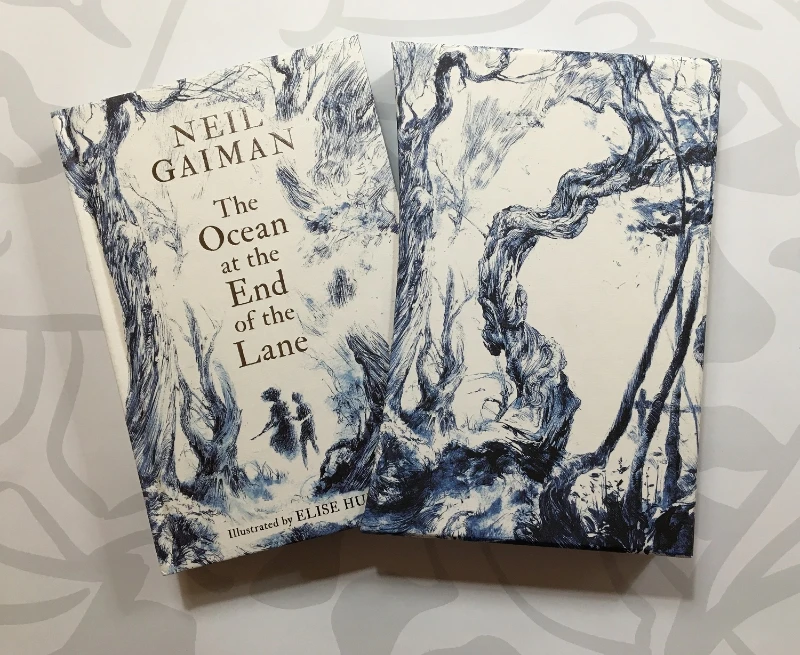
A collector's breakdown of The Ocean at the End of the Lane by Neil Gaiman, mapping the full family of editions from the 2013 first printing to the 2019 illustrated deluxe. Covers publishing history, the signed and numbered variants, how to tell the two illustrated deluxes apart, and what serious collectors should prioritise when building a set.
Why This Book Matters to Collectors
Neil Gaiman occupies a rare position in contemporary fiction: a genuinely literary voice who also happens to be one of the most collected authors alive. Among his adult novels, The Ocean at the End of the Lane stands out as arguably his most personal work — a slim, dreamlike novel about memory, childhood, and the ancient forces that hide behind an ordinary English lane. What makes it unusually rewarding to collect is that it exists in two separate illustrated incarnations, each the work of a different artist, bracketing the book's life at either end: a full-colour Dave McKean limited edition in 2013, and a black-and-white Elise Hurst programme in 2019. Together with the original trade first edition, they give collectors a genuine hierarchy to pursue rather than a single target.
A Brief Synopsis
An unnamed middle-aged man returns to his childhood village for a funeral and finds himself drawn back to the farmhouse at the end of the lane, where a girl named Lettie Hempstock once told him the pond behind her house was an ocean. What follows is a recovered memory of a single, terrifying childhood summer — one involving ancient beings, a malevolent nursery-rhyme monster, and a sacrifice made on his behalf that he had long forgotten. It is Gaiman at his most intimate: shorter and quieter than American Gods or Neverwhere, but arguably his most emotionally exacting book, and one that critics singled out on release for the way it folds adult reckoning inside the structure of a fairy tale.
Publishing History
The Ocean at the End of the Lane was first published in June 2013 — by Headline in the UK and William Morrow in the US — to significant critical acclaim, quickly becoming a bestseller and cementing its place alongside Gaiman's most celebrated adult fiction. That original trade edition carried no illustrations; it is the pure first-edition text that most readers know.
The book's collecting life proper began almost immediately, with a US deluxe signed limited edition from William Morrow, illustrated in full colour by Dave McKean and limited to 2,000 signed and numbered copies. McKean's involvement is significant in its own right: he and Gaiman share one of the longest and most celebrated author–illustrator partnerships in the field, running from Violent Cases (1987) and Black Orchid (1988) through every cover of The Sandman (1989–96) and on to the children's books The Day I Swapped My Dad for Two Goldfish, Coraline, The Wolves in the Walls, The Graveyard Book and Crazy Hair, plus the film MirrorMask. A McKean-illustrated Gaiman limited is therefore not a novelty pairing but a continuation of a decades-long collaboration — part of what gives the 2013 deluxe its standing.
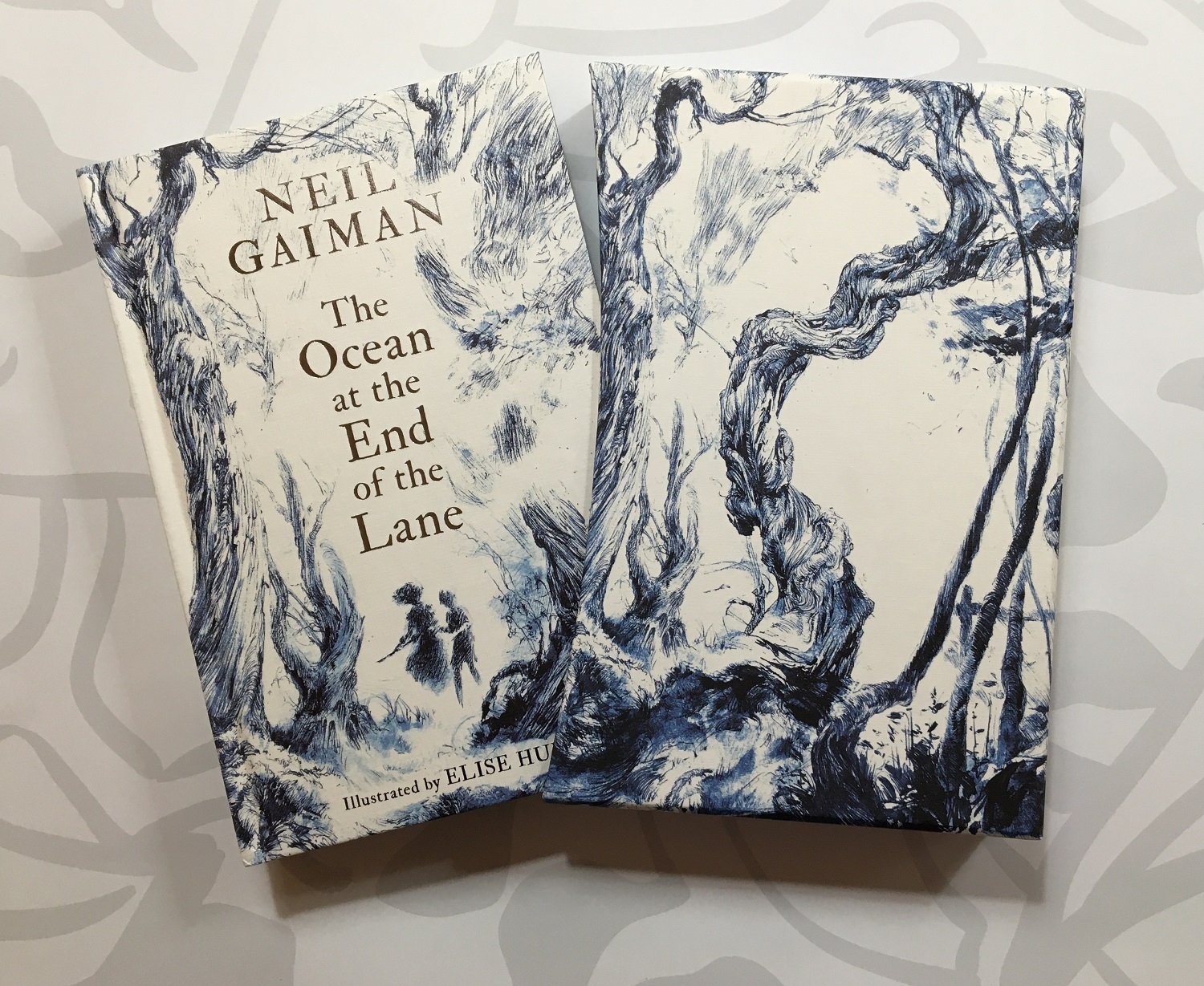
Six years later the novel received a second, entirely different illustrated treatment: the 2019 illustrated edition from Headline (UK), featuring black-and-white artwork throughout by fine artist Elise Hurst. Over roughly two years Hurst produced around 101 pen-and-ink illustrations for the book. Her images do not merely decorate the text — they extend its atmosphere, rendering the Hempstock farm, the ocean-pond, and the novel's stranger moments with a hand that favours suggestion and shadow over literal depiction, a style well suited to a story built on half-remembered dread. This 2019 programme appeared in a standard illustrated hardback, an illustrated paperback, and — at the top of the range — a signed and numbered slipcased deluxe limited to 1,000 copies.
The Four Principal Editions
Set out chronologically, the collecting landscape resolves into four main editions plus paperback issues:
| # | Edition | Year | Illustrator | Key Features |
|---|---|---|---|---|
| 1 | Trade First Edition | 2013 | — (unillustrated) | The original first-edition text; Headline (UK) / William Morrow (US). Signed copies exist |
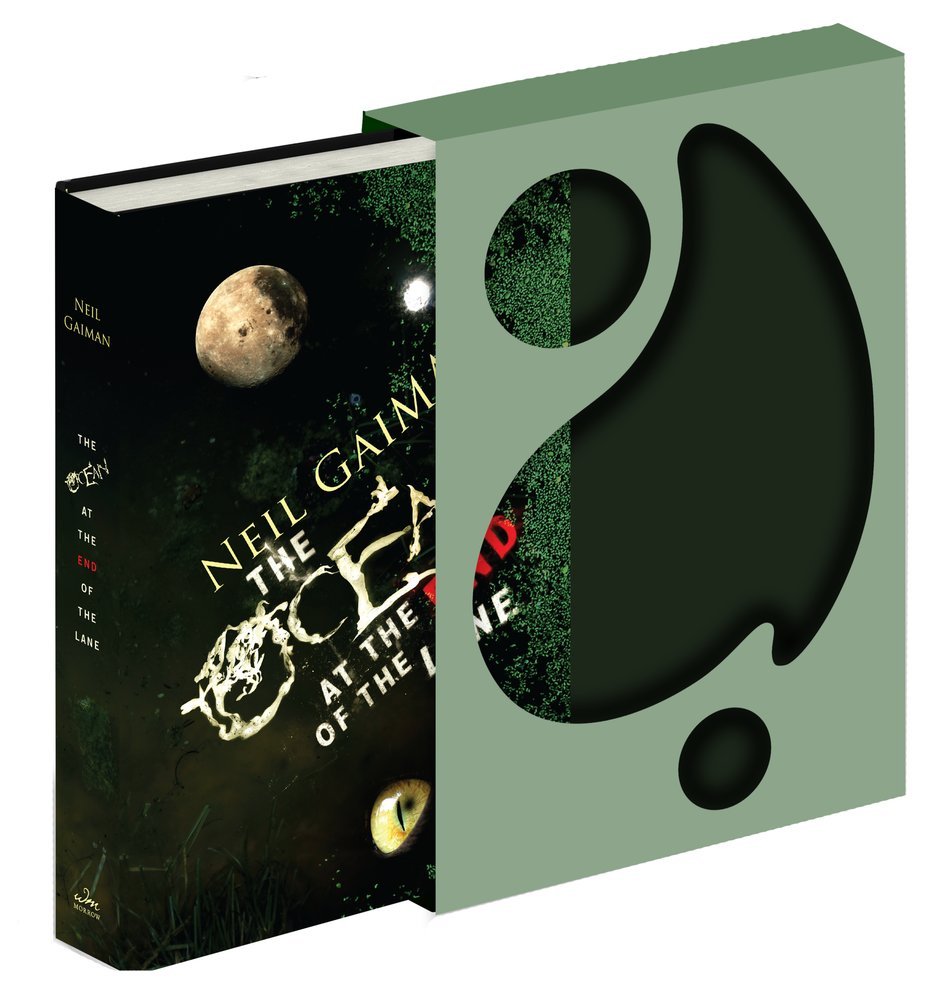
| 2 | Illustrated Deluxe (McKean) | 2013 | Dave McKean | Signed & numbered, limited to 2,000; full-colour McKean artwork, die-cut silk-bound slipcase, heavy matte stock (William Morrow, US). Smaller signed states also produced |
| 3 | Illustrated Edition (Hurst) | 2019 | Elise Hurst | Standard hardback with the full black-and-white illustration programme; Headline (UK). Signed and retailer-exclusive states exist |
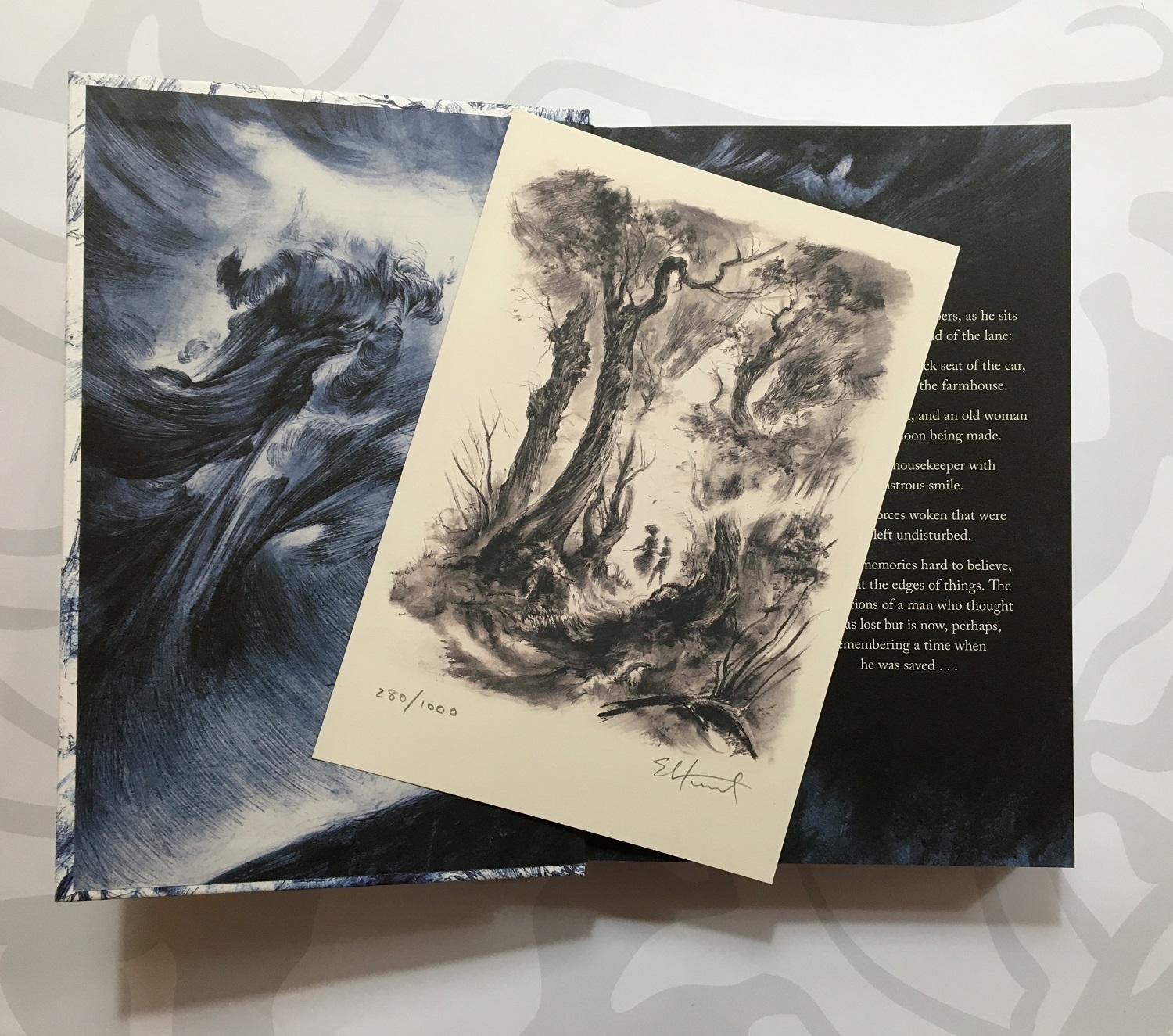
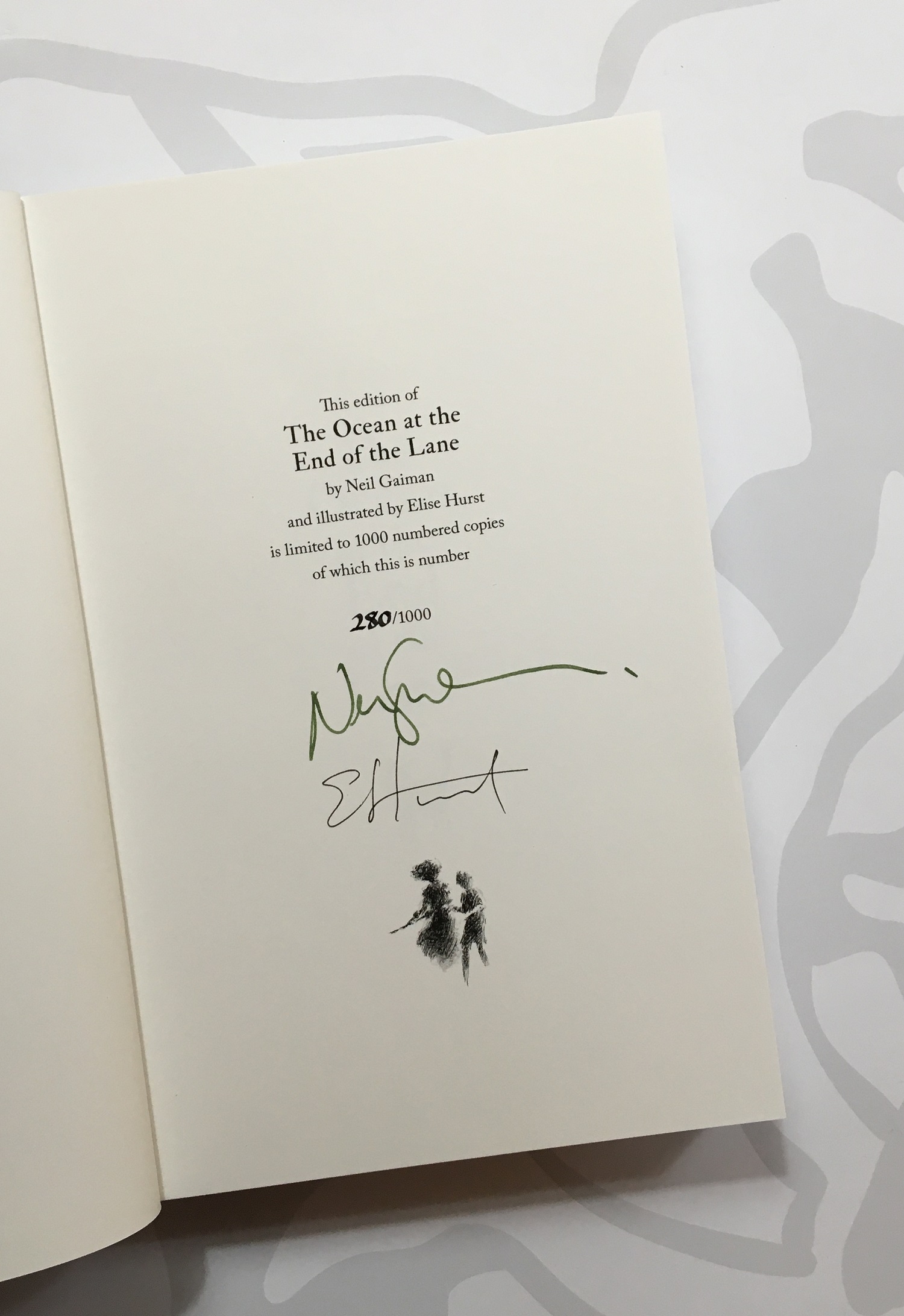
| 4 | Illustrated Deluxe Slipcase (Hurst) | 2019 | Elise Hurst | Signed by both Gaiman and Hurst; limited to 1,000 numbered copies. Illustrated slipcase, white cloth boards with blue detail, ribbon marker, and a matching-numbered art print separately signed and numbered by Hurst |
Beyond these, both illustrated programmes were also issued in paperback, and the 2019 illustrated paperback appears in signed states — the most accessible entry point for collectors on a modest budget.
Which Deluxe Is Which — Avoiding the Common Mix-Up
Because two different "deluxe signed" editions of the same title exist, listings are frequently confused. The quickest way to tell them apart:
- 2013 McKean deluxe — full-colour interior art, limited to 2,000, US (William Morrow), die-cut silk slipcase.
- 2019 Hurst deluxe — black-and-white interior art, limited to 1,000, UK (Headline), illustrated slipcase with a signed/numbered art print, and signed by both author and illustrator. If a copy is slipcased, numbered out of 1,000, illustrated in black and white, and carries two signatures, it is unambiguously the 2019 Hurst deluxe — the newer and, at present, the scarcer of the two by print run.
The Collector's Guide
A few practical principles apply here, as with any modern illustrated limited:
Prioritise the numbered deluxes. Within either illustrated line, the signed and numbered slipcased deluxe is the format to secure where budget allows — numbering adds a layer of scarcity that a plain signed edition cannot replicate. The 2019 Hurst deluxe (/1,000) is the tighter run.
Condition is everything. Illustrated editions live or die on the crispness of their artwork reproduction and the integrity of the slipcase and boards; foxing, rubbing, or a bumped spine will materially affect desirability even on a signed and numbered copy. For the Hurst deluxe, check that the separately numbered art print is present and its number matches the book.
Value the dual signature. The 2019 Hurst deluxe is signed by both Gaiman and Hurst — a genuine two-hand piece rather than a single author signature. Verify both signatures and, for any numbered copy, seek clear provenance. Flat-signed copies generally command a premium over tipped-in bookplates.
Don't overlook the paperback. The signed illustrated paperback is an underrated entry point — it carries the same Hurst artwork at a fraction of the outlay of the hardback tiers, and makes a sensible "reading copy" companion to a deluxe kept pristine.
Buy the artist as much as the author. Both illustrated editions are true collaborative achievements, not licensed add-ons. McKean's colour work belongs to a partnership stretching back to the 1980s; Hurst's painterly, gallery-adjacent hand is uncommon in mass-market illustrated fiction. Copies should be evaluated with illustration quality in mind, not solely Gaiman's signature.
Secondary Market Values
The secondary market for this title is active, not dormant. As of July 2026, the 2019 Hurst signed-and-numbered slipcase deluxe can be found on the open market: recent UK listings include an opened, signed copy at around £119 and a sealed copy complete with launch materials at around £179, alongside stock at specialist dealers such as Very Fine Books, Camelot Books, Coles Books and The Gently Mad Book Shop. The 2013 McKean deluxe (/2,000) trades separately and, being the older limited, commonly reaches higher figures again.
As a general hierarchy for the title:
- Signed paperback (illustrated): the entry-level collectible tier.
- Signed standard hardback (2019 illustrated): mid-tier, typically outperforming a plain signed first thanks to the artwork.
- 2019 Hurst signed & numbered deluxe (/1,000): the top of the current UK market for the illustrated line — roughly £120–£180 at recent asking prices, condition dependent.
- 2013 McKean signed & numbered deluxe (/2,000): a parallel top tier, generally trading higher still. Condition remains the primary driver of value, and all figures should be treated as approximate — a guide to recent asking prices rather than guaranteed realised values — until confirmed against comparable recent sales.
Snap Facts
- The book carries two entirely separate illustrated editions by two different artists: Dave McKean's full-colour 2013 deluxe (limited to 2,000) and Elise Hurst's black-and-white 2019 programme (deluxe limited to 1,000). They are frequently confused in listings.
- The 2019 Hurst deluxe is signed by both author and illustrator, and includes a matching-numbered art print separately signed and numbered by Hurst — a rare two-hand piece in Gaiman's modern backlist.
- Elise Hurst's edition is entirely black-and-white — a deliberate choice mirroring the novel's memory-haunted, half-lit tone rather than a cost-saving measure.
- Gaiman and McKean share one of the longest author–illustrator partnerships in the field, from Violent Cases and the Sandman covers to Coraline and The Graveyard Book; the 2013 deluxe sits squarely within that lineage.
- The novel began, by Gaiman's own account, as a short story written for his wife — a detail that surprises readers who assume its dark mythology was designed from the outset as a full novel.
- Despite its fairy-tale trappings, the book was originally marketed and shelved as adult fiction, not fantasy for younger readers — a classification that has occasionally confused new collectors browsing backlist Gaiman.
Disclaimer: Valuations are estimates based on recent secondary market activity and should be treated as guidance only. Market conditions change; always verify current prices with specialist dealers before buying or selling.
© 2026 thebook.buzz. Original content — all rights reserved. Reproduction without permission is prohibited.